


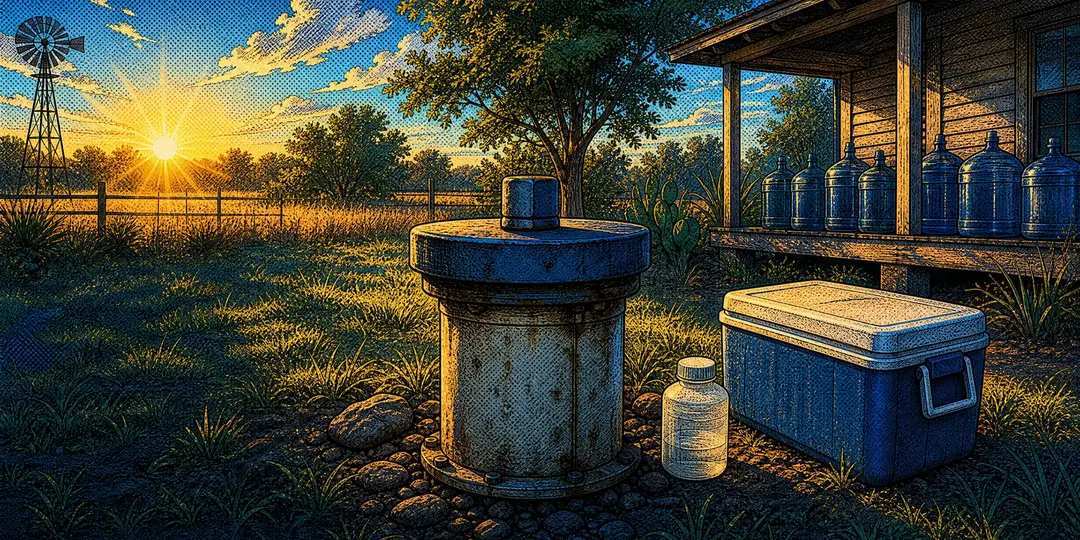
Water comes first because nothing else in a household plan works without it and it costs almost nothing to store. The rule is one gallon (3.8 L) per person per day, for at least fourteen days. Then you need a way to make other water safe, and a list of where that other water is. This emergency water storage guide covers all three: storing, treating and finding water for an ordinary house, from the first jug to a filter plan.
The quantity rule and its exceptions
FEMA and the CDC both use one gallon per person per day as the baseline: roughly half a gallon to drink and the rest for cooking and basic hygiene. The CDC asks for a minimum of three days and a two-week supply if possible. Three days covers a storm; it does not cover a week-long boil-water notice or a burst main in a hard freeze, so fourteen days is the number to plan for.
Store more than the baseline for:
- Hot weather. FEMA notes that heat can double the amount a person needs to drink.
- Pregnant or nursing women, and anyone ill, especially with fever, vomiting or diarrhea.
- Infants on formula, who need clean water for every bottle.
- Pets. A common rule of thumb is about an ounce of water per pound of body weight a day for dogs and cats, so roughly half a gallon for a large dog.
For a family of four that is 56 gallons before the extras. The worked numbers, the container choices and where to put them in a real house are in how much water to store, and where to put it. The rest of this guide is about what surrounds that store.
Where the water lives
| Source | Typical amount | Use for | The catch |
|---|---|---|---|
| Stored containers | Whatever you filled | Drinking and cooking | Needs rotating every 6 months (CDC) |
| Water heater tank | 30–80 gal, often 40–50 | Drinking after treatment, cooking, washing | Power or gas off first; sediment at the bottom |
| Household pipes | A few gallons | Drinking if the supply was safe when it stopped | Only once; contaminated if a boil notice came first |
| Bathtub bladder liner | Up to about 100 gal | Drinking and cooking, filled before a storm | Needs a forecast; the liner is single-purpose gear ($25–45) |
| Bare bathtub | 40–80 gal | Flushing and washing | Not for drinking: tub surfaces and drains are not clean |
| Toilet tank (not bowl) | 1.5–3 gal per tank | Flushing | Skip if you use in-tank cleaners |
| Ice, canned fruit and vegetable liquid | Small | Drinking, cooking | Small amounts, but already clean |
Draining the water heater. Turn off the power at the breaker (electric) or set the gas control to “pilot” or off (gas). Close the cold-water supply valve at the top of the tank so contaminated city water cannot refill it. Open a hot-water faucet somewhere in the house to let air in, then open the drain valve at the bottom into a clean container. The first water may carry rust or sediment; let it settle, then treat it. Do not turn the heater back on until the tank is full again. Learn where the valves are on a calm afternoon, not in the dark.
Draining the pipes. If the water was safe when it stopped, open the highest faucet in the house to let air in and collect from the lowest one. If a boil notice was in force first, treat what comes out.
Treating water: what each method does and does not do
No single household method removes everything, and the difference matters. Germs (bacteria, viruses and protozoa such as Giardia and Cryptosporidium) are the main risk from doubtful water. Chemicals such as fuel, pesticides and industrial runoff are a different problem that most home methods cannot touch.
| Method | Bacteria | Viruses | Protozoa | Chemicals | Notes |
|---|---|---|---|---|---|
| Boiling, 1 minute (3 above 6,500 ft) | Yes | Yes | Yes | No | Most reliable; costs fuel |
| Unscented household bleach | Yes | Yes | Partly (Giardia moderately; Cryptosporidium no) | No | 30-minute wait; cheap |
| Chlorine dioxide tablets | Yes | Yes | Yes, with the long contact time on the label | No | Follow the label; $10–20 a pack |
| Iodine tablets | Yes | Yes | Partly (not Cryptosporidium) | No | Not for pregnancy or thyroid conditions |
| Hollow-fiber filter (0.1–0.2 micron) | Yes | Usually no | Yes | No | No wait; clogs on dirty water |
| Activated-carbon filter | No | No | No | Reduces some, plus taste and odor | Pair with a filter or disinfectant |
Bleach ratios. The EPA figure for regular unscented bleach is 8 drops per gallon for 6% bleach, 6 drops for 8.25%, doubled if the water is cloudy, colored or very cold. Stir, wait 30 minutes, and check for a faint chlorine smell; if there is none, dose again and wait 15 more minutes. Use plain unscented bleach only, never scented, splash-less or “with cleaners,” and check the strength on the label. The household bleach ratio card has the table for larger volumes.
Cloudy water first. Let it settle, pour off the clear part, and strain through a clean cloth or coffee filter before any treatment. Sediment shields germs from chlorine and clogs filters.
The combination that covers most risks is a filter followed by a disinfectant: the filter takes out protozoa and sediment, and bleach or tablets take care of viruses. That is the logic behind a bucket water filter for under $40, which turns a pair of food-grade buckets into a household-scale filter.



 4
Comments
No comments yet. Read the comment guidelines before posting.