A neat, square stack of blue rectangular water storage cubes in the corner of a hall closet, each layer sitting flush on the one below, every cube with a carry handle, a cap and a blank fill-date label.
How much water to store per person: one gallon a day for fourteen days, in food-grade containers somewhere cool and dark. The numbers, containers and shelf.
Sixteen 3.5-gallon bricks: two weeks for a family of four, in the footprint of a washing machine.
On how much water to store per person, the standard guidance from FEMA and the CDC is one gallon (3.8 L) per person per day. About half of that is for drinking; the rest covers cooking, basic hygiene and brushing teeth. It is a floor, not a target, and it says nothing about where 56 gallons is supposed to go in a house that already has a full hall closet. This guide does the arithmetic, compares the containers, and finds the space.
How much water to store per person: the math
The CDC asks for at least three days and a two-week supply if possible. Three days covers a storm. It does not cover a boil-water notice that runs a week, or a pipe burst in a cold snap when every plumber in the county is booked. We plan for two weeks and consider that the honest minimum for a household.
Household
3 days
14 days
30 days
1 adult
3 gal
14 gal
30 gal
2 adults
6 gal
28 gal
60 gal
2 adults, 2 kids
12 gal
56 gal
120 gal
+ 1 large dog
+1.5 gal
+7 gal
+15 gal
The dog line uses a common rule of thumb of about an ounce of water per pound of body weight a day, which puts a 60–70 lb dog at roughly half a gallon. A cat needs far less, but count it anyway.
Then adjust up. FEMA notes that hot weather can double what a person needs to drink, and pregnant or nursing women, sick people and infants on formula need more. If your summers are hot or someone in the house fits that list, add a quarter to the total rather than calculating it to the cup.
Fifty-six gallons sounds like a lot. It weighs about 470 lb (213 kg), since water is roughly 8.3 lb a gallon, and it is sixteen 3.5-gallon bricks, which stack four high in about the floor space of a washing machine. The water storage worksheet does the math for your household on one page.
What to store it in
Anything food-grade, clean and opaque, with a tight cap. Sunlight grows algae, so clear containers live in the dark. In rough order of preference for a normal house:
Container
Weight full
Cost per gallon of capacity
Good for
Watch out for
Stackable 3.5–5 gal bricks
30–42 lb
$4–7
Closets, under beds, apartments
Highest cost per gallon
5–7 gal jugs with spigot
42–58 lb
$2–4
Pantry floor, garage shelf
Heavy to lift at the top end
Sealed bottled water
By the case
$1–2 (you are buying the water too)
Grab-and-go, rotates as you drink it
Bulky for the volume; use by its date
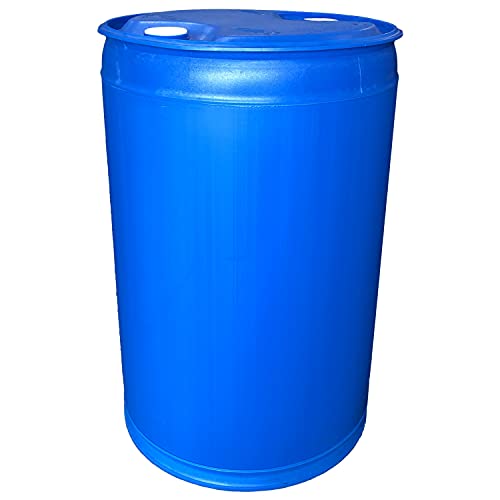
55 gal drum
About 460 lb
$1–2, plus a $15–30 pump
Basements and garages with a level floor
Cannot be moved once filled
Bathtub bladder liner
Stays in the tub
$25–45 for up to about 100 gal
Top-up filled when a storm is forecast
Not storage; needs warning
Stackable 3.5–7 gallon containers are the default. They fit closets, carry with one hand at the smaller size, and need no pump. Commercial bottled water, still sealed, is cheap and rotates itself if you drink from it and replace it, but cases take a lot of room for the volume. Clean PET soda bottles work too, rinsed and sanitized, and are free. 55-gallon drums have the best cost per gallon, but need a pump, a bung wrench, a level floor and a plan for never moving the drum again. A bathtub bladder is a last-minute top-up filled when a hurricane or ice storm is forecast, not storage.
From the case of bottles to the drum. Cost per gallon falls as size rises; so does how easily you can move it.
Do not reuse milk or juice jugs. FEMA and the Red Cross both advise against them: the thin plastic degrades and splits within months, and milk proteins and sugars cannot be fully cleaned out. Never use a container that once held chemicals, however well rinsed.
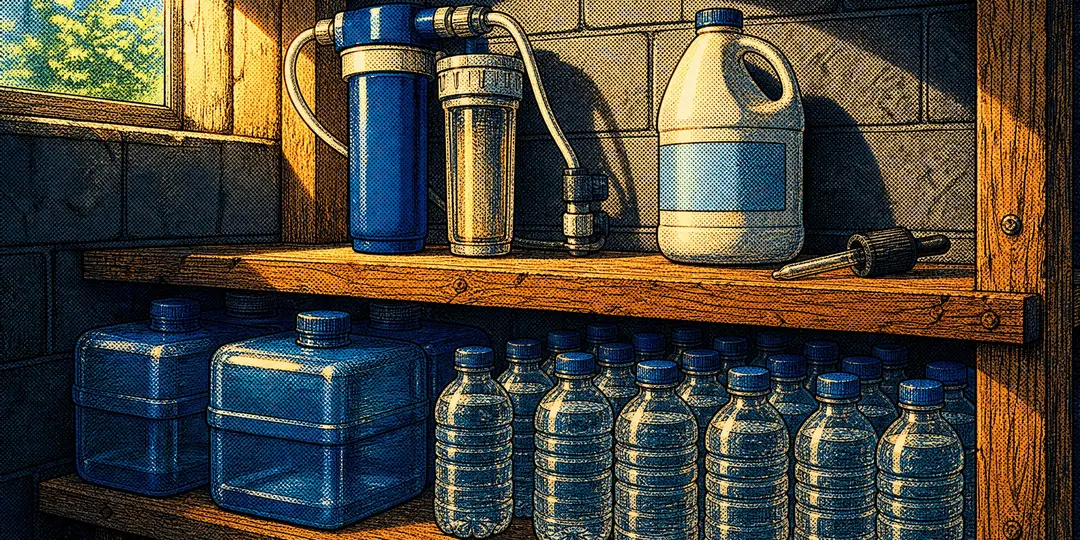
Clean before you fill. Wash with soap and water, rinse, then sanitize with 1 teaspoon of unscented bleach in a quart of water, swished over every inside surface. Wait at least 30 seconds, pour it out and let the container air dry. That is the CDC method, and it takes a few minutes per container.
Cool, dark and away from chemicals. The CDC suggests 50–70°F (10–21°C), out of direct sunlight, and away from gasoline, paint and pesticides, whose vapors can taint water through plastic. In practice:
A hall or bedroom closet floor. Indoors, stable temperature, easy to reach. The best spot in most houses.
Under beds. Low bricks slide under a bed frame with 7 inches or so of clearance. Eight bricks (28 gallons) is two weeks for two people.
The bottom of a pantry, next to the food, so both get checked together.
A basement, ideal unless it floods. Put containers on a shelf or pallet, not straight on a floor that takes water.
A garage, if it does not freeze in winter or bake in summer. Use the corner against the house wall, keep the water well away from the mower, gas can and pool chemicals, and check it more often.
Split the supply between two places if you can. A burst pipe or a flooded basement should not take all of your water with it, and a few gallons next to the home kit means the first three days can leave with you.
Mind the weight. A 55-gallon drum on an upper floor is a question for whoever knows your joists; on a slab or in a basement it is fine.
Apartments
Eight to fourteen bricks fit under a queen bed with clearance, which is two weeks for two people with room to spare. Add a bathtub bladder for storms and a case of bottled water in a closet. See prepping in 600 square feet for the full small-space layout.
"Stored water needs nothing. A filter needs a source. Buy the containers first."
From this guide
Rotation: six months, on the calendar
The CDC says to replace water you have stored yourself every six months, and to observe the expiration date on bottled water. Write the fill date on every container in marker and put the next change in your calendar, ideally with the clock change in spring and fall so it becomes a habit.
Tap water from a chlorinated public supply needs nothing added at fill time. Well water or other untreated water should be disinfected before storage; the EPA ratio is 8 drops of 6% unscented bleach per gallon (6 drops of 8.25%), and the household bleach ratio card has larger volumes. Commercial water-preserver concentrates are sold with claims of up to five years of storage; if you use one, follow its label exactly and treat that figure as the maker’s claim, not official guidance.
On change day, use the old water: the garden, the car, a mop bucket. Then wash, sanitize and refill.
Stored water that tastes flat is fine; pour it between two clean containers a few times to put air back in. Water that smells of anything else, looks cloudy or has growth in it gets discarded, the container cleaned, and the supply refilled.
If fourteen days is too much this month
Start with three days and build. For a family of four that is 12 gallons: two 7-gallon jugs with a little to spare, or four cases of bottled water. Then add a container a payday until you reach the fourteen-day line. The containers are the only real cost; the water itself is from the tap and costs pennies a gallon.
What not to do is wait for the perfect container system. A rinsed, sanitized soda bottle filled tonight is worth more than a drum you have not bought. Mixed containers are fine as long as each one is food-grade, clean, capped and dated. Prepping on $25 a week puts the water containers in its first weeks for the same reason.
What to do next
Buy the containers this week. Fill them this weekend. Write the date on each one. Then read Water storage 101 for treatment and the water already hidden in your house, or build a bucket water filter for under $40, so you have a plan for day fifteen.
Quick answers
How much water should a family of four store?
Fifty-six gallons (212 L) for two weeks: one gallon per person per day for drinking, cooking and basic hygiene. Add about half a gallon a day for a large dog, and more in hot weather or for anyone pregnant, nursing or ill. Fifty-six gallons is sixteen 3.5-gallon containers, about the floor space of a washing machine.
How often should you replace stored tap water?
Replace tap water you have stored yourself every six months, as the CDC advises, and observe the expiration date on commercial bottled water. Write the fill date on every container and set a calendar reminder, ideally on the spring and fall clock changes. Use the old water on the garden, then wash, sanitize and refill the containers.
Can you store drinking water in milk jugs?
No. FEMA and the Red Cross both advise against storing drinking water in milk or juice jugs: the thin plastic degrades and splits within months, and milk proteins and sugars cannot be fully cleaned out. Use food-grade water containers, sealed bottled water or rinsed and sanitized PET soda bottles, and never use a container that once held chemicals.
Where is the best place to store emergency water?
A hall or bedroom closet floor is the best place to store emergency water in most houses: indoors, at a stable temperature and easy to reach. The CDC suggests 50–70°F (10–21°C), out of direct sunlight and away from gasoline, paint and pesticides. Split the supply between two places so one burst pipe or flood cannot take it all.
Do you need to add bleach to stored tap water?
Not if it comes from a chlorinated public supply; that tap water needs nothing added at fill time. Well water or other untreated water should be disinfected before storage, using the EPA ratio of 8 drops of 6% unscented bleach per gallon, or 6 drops of 8.25% bleach. Commercial water preservers should be used exactly as their label says.
Printable
Water storage worksheet (PDF, 1 page). Household size, gallons needed, container count, fill date, rotation date.
Picks that match the specs in this guide, from makers with a track record. We haven't tested them yet. As an Amazon Associate we earn from qualifying purchases, at no cost to you. Add what you need to my list, then send the whole list to your Amazon cart all at once. Prices and availability are accurate as of the date and time shown and are subject to change. The price and availability shown on Amazon.com at the time of purchase will apply.
Scepter
Scepter Flow Control 5-Gallon Water Jug with Spigot
A food-grade 5-gallon water can from a maker of military water containers. Stands upright to carry, lies flat to pour.
No price from Amazon right now (checked Nov 24, 6:06 a.m. CT)
Good to know: About 43 lb full. Wash it before the first fill: new jugs can smell of plastic.
Shane is a disabled US Army veteran who served as an M1A1 tank crewman, then spent his career in technology and manufacturing supply chains, keeping parts moving through COVID. He, his wife Heather and their three kids have ridden out tornadoes, the February 2021 Texas freeze, the 2026 floods in Northeast Texas and power outages that lasted days. He started Prepping Expert to give families the plain, affordable, step-by-step version he wished he'd had.
Emergency water storage in one guide: the 1-gallon, 14-day rule, the 30–80 gallons in your water heater, treating doubtful water, and what never to drink.
How often to test well water: once a year for coliform bacteria, nitrates, pH and dissolved solids, and again after any flood. Plus how to check stored water.
Ten one-pot emergency pantry meals for four, made entirely from the two-week shelf, each with a no-cook fallback and a fuel cost you can count in canisters.
We use Google Analytics cookies to count visits and see which guides help. No ads, nothing sold. Cookie policy






 3
 4

Comments
No comments yet. Read the comment guidelines before posting.