The entry-level US amateur license takes one test, the ham radio Technician exam: 35 multiple-choice questions drawn from a published pool of about 400, and you need 26 right. Every question and its answer is public. A month of 20–30 minutes a night on a free practice site, one exam session, and about $50 in fees gets most adults through the first time.
This guide is the month: what’s on the exam, where to study, a week-by-week plan, how to find a session, the paperwork that follows, and the first radio. If you are still deciding whether ham is the right radio for your household at all, start with GMRS, ham and Meshtastic for a family.
What the ham radio Technician exam actually is
The Technician exam (officially “Element 2”) is set by volunteer examiners, not the FCC directly, from a question pool written by the National Conference of Volunteer Examiner Coordinators. The current pool took effect on Jul 1, 2026 and runs to Jun 30, 2030. It has 409 questions in 35 groups, and your exam takes one question from each group.
The subject matter splits roughly into three:
- Rules: what Technicians may do, which frequencies they may use, identifying with your call sign, what you can’t transmit (music, business, coded messages).
- Operating practice: how repeaters work, how to make a call, emergency communications, safety around antennas and RF exposure.
- Electronics and radio theory: Ohm’s law, frequency and wavelength, basic circuit parts, how radio waves travel. This is the part people fear and the part that has the fewest questions.
There is no Morse code and no practical test. Pass, and you get privileges on every amateur band above 50 MHz, which covers the handheld radios, repeaters and local nets that matter for preparedness, plus some limited shortwave privileges.
Where to study (most of it free)
| Resource | Cost | Best for |
|---|
| HamStudy.org (site and app) | Free on the web; small charge for the phone app | Flashcard-style study that tracks which questions you keep getting wrong |
| Free practice-exam sites | Free | Full 35-question timed mock exams |
| The ARRL Ham Radio License Manual | About $30–35, check the current price | People who want to understand the material, not just pass |
| Free study guides and video courses | Free to about $10 | Explaining the theory section in plain English |
Whatever you use, check that it covers the 2026–2030 pool. Older material from the 2022 pool overlaps heavily, but about 30 questions were removed and roughly 150 reworded, so practice tests from the old pool will mislead you near the end.
Two approaches work. Memorizing the answers gets you through but leaves you unable to use the radio. Understanding the reason behind each answer takes perhaps a week longer and is the version that pays off when a repeater doesn’t respond and you need to work out why. Aim for the second, and accept the first for the theory questions that make no sense yet.
The four-week plan
Week 1: rules and operating. Twenty to thirty minutes a night on the rules and operating sections. These are the easiest points and the most useful for actually talking on the air. At the end of the week, register for an FCC Registration Number (FRN, below). You need it to take the exam.
Week 2: electronics and theory. Ohm’s law, frequency and wavelength, units, components. Write the handful of formulas on a card and keep it by the kettle. Take your first full mock exam on the weekend. Expect a fail; it tells you what to fix.
Week 3: antennas, propagation and safety. Then go back through every question you have missed so far. Book an exam session for the end of week four now, because the ones nearby fill up.
Week 4: mock exams. One full practice test a night. When you are scoring 30 or more out of 35 on three tests in a row, you are ready. If you aren’t by the end of the week, move the session; it is cheaper than retaking.
Finding a session and paying the fees
Exams are run by teams of three volunteer examiners under a Volunteer Examiner Coordinator (VEC). Search for sessions by ZIP code on HamStudy or on the ARRL’s exam session search. Local radio clubs often hold one a month, sometimes at a library or fire station.
In person: bring a government photo ID, your FRN, a pen and pencils, and the session fee, which is commonly $15 (some VECs charge less or nothing, and some reduce it for under-18s). Check whether the team wants a check or cash.
Online: several VEC teams run remote sessions over video. You need a quiet room, a computer with a webcam, and usually a second camera or phone to show the room. They are convenient but slots go quickly.
The paperwork:
- Before the exam: create an account in the FCC’s CORES system and get your FRN. Ten minutes, free.
- At the exam: the team files your application electronically after you pass.
- After the exam: the FCC emails you instructions to pay the $35 application fee. Pay it promptly; nothing happens until you do.
- Your call sign appears in the FCC’s license database, usually within days to a couple of weeks. You may transmit once it is listed. The license lasts ten years.
There is no minimum age for a ham license, so an interested teenager can take it too.
The first radio, for under $50
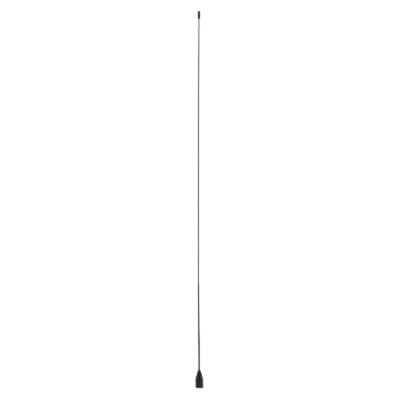
A dual-band handheld covering 2 meters and 70 centimeters (the two bands local repeaters use) costs $30–50. Cheap ones work, with two known trade-offs: the stock antenna is poor, and programming them from the keypad is miserable. Spend $15–25 on a better antenna and use free programming software and a cable on a laptop to load your local repeaters.
Buy it in week three, not week one, and only listen until the license arrives. Listening is legal for anyone and is the best study aid there is.
Week one on the air
- Find your local repeaters with an online repeater directory, and program the two or three nearest, including any tone they need.
- Listen for a few evenings. Learn how people call, how long they talk, and how they identify.
- Make your first call. Say your call sign and “listening.” Someone usually answers; ask them how well you are being heard from your house.
- Check in to a net. Most areas run a weekly net, often for emergency practice. Checking in is a matter of saying your call sign when the net control station asks for check-ins.
- Find the club. The local club or ARES group (Amateur Radio Emergency Service) is where you learn what works in your town, and where your new license becomes useful to more people than just you.
Then fold the radio into the family plan: which repeater you’ll use, at what times, and how the rest of the household reaches you on their GMRS or FRS radios. Family emergency planning covers the rest of that conversation.
Quick answers
How many questions are on the Technician ham exam?
The US amateur radio Technician exam has 35 multiple-choice questions, and you need 26 correct to pass. Each question is drawn from one of 35 groups in a public pool of 409 questions, the pool in effect from Jul 1, 2026 to Jun 30, 2030. Every question and its answer is published in advance, so you can practice on the real material.
How much does it cost to get a ham radio license?
A US Technician ham radio license costs about $50 in fees: a typical $15 exam session fee, though some volunteer examiner teams charge less or nothing, plus the FCC’s $35 application fee after you pass. Getting an FCC Registration Number is free. A first dual-band handheld radio adds roughly $30–50.
How long should I study for the Technician exam?
Most adults pass the Technician exam after about four weeks of 20–30 minutes of study a night on a free practice site. A good sign you are ready is scoring 30 or more out of 35 on three full practice tests in a row. If you are not there by your session date, moving the exam is cheaper than retaking it.
Do you need Morse code for a ham radio license?
No. The US Technician exam has no Morse code requirement and no practical test, only the 35-question written exam. Passing gives you privileges on every amateur band above 50 MHz, which covers the handheld radios, repeaters and local nets that matter for household preparedness, plus some limited shortwave privileges.
How soon can I transmit after passing the ham exam?
You can transmit once your call sign appears in the FCC’s license database, usually within days to a couple of weeks after you pass. Nothing happens until you pay the FCC’s $35 application fee, which the FCC emails you instructions for after the exam team files your application. The license then lasts ten years.
Printable
Skills inventory checklist (PDF, 1 page). A line for the license, the date you passed and the next skill to practice.






 4

Comments
No comments yet. Read the comment guidelines before posting.