


The lumen figure is the biggest number on the box and the least useful one. For a household light, the things that decide whether it helps during an outage are how long it runs on a low setting, what battery it takes, whether the switch works when your hands are cold and full, and whether the beam lights a room or a spot at the end of the street. Get those right and almost any brightness above about 200 lumens is enough.
This guide explains how to choose a flashlight: how to read the spec sheet, which battery system makes sense for a family, which beam shape to choose, and three sensible budgets. If you only buy one light per person, make it a headlamp; the headlamp guide explains why. A flashlight is the second light: for walking the yard, checking the basement, the car and the kit.
Why lumens mislead
Lumens measure total light output, and the number on the box is usually the highest setting, measured in the first moments after switch-on. Many lights can’t hold that output for long. They step down after a minute or two, often to a third of the headline figure or less, to stop the light from overheating or the battery from sagging. A “1,000-lumen” light might spend most of its life at 300.
More to the point, you rarely want maximum output indoors. In a dark house, 20–60 lumens is enough to cook, read and move around, and 1–5 lumens is enough to get to the bathroom at night without waking everyone. What matters during a multi-day outage is how many nights a set of batteries lasts at those low levels.
Reading a spec sheet: the ANSI FL1 numbers
Most reputable flashlights publish figures measured to the ANSI/PLATO FL1 standard, which defines how each number is measured so you can compare between brands. In plain words:
| FL1 figure | What it measures | What it tells you |
|---|---|---|
| Light output (lumens) | Total light, measured from 30 seconds to 2 minutes after switch-on | Brightness at the start, not over time. Least useful number. |
| Run time (hours) | Time until output falls to 10% of the starting figure | The important one, per mode. Note that "10%" can mean a very dim light by the end. |
| Beam distance (m) | How far the beam stays bright enough to see by (0.25 lux, about full moonlight) | Throw. Matters outside, not much indoors. |
| Peak beam intensity (candela) | Brightness at the center of the beam | High candela with modest lumens means a tight spot beam. |
| Impact resistance (m) | Drop height onto concrete it survived, still working | 1 m is the minimum; 1.5–2 m is better for a kit light. |
| Water resistance (IPX rating) | IPX4 splash-proof; IPX7 survives brief immersion; IPX8 deeper, as stated | IPX4 is fine for rain; IPX7 if it might be dropped in water. |
Two things to watch. First, check which battery the run-time figures were measured with; lithium AA figures look better than alkaline or rechargeable. Second, look for a runtime graph if the maker publishes one. A flat line that drops at the end is a regulated light, which holds steady brightness; a steady slope is unregulated, which dims gradually. Regulated is nicer to use; unregulated tells you when the battery is going.
If a light publishes only lumens and no FL1 runtimes, treat the lumen figure as optimistic.
Battery choice for a household
The battery decision is the real flashlight decision, because it decides what you stock and whether lights, radios and remotes can share.
| Battery | Strengths | Trade-offs | Best for |
|---|---|---|---|
| AA (alkaline, lithium or NiMH) | Sold everywhere; cheap; shared with radios, remotes and toys; rechargeable NiMH works in most AA lights | Less runtime per cell than lithium-ion; alkalines can leak in storage | The household system. Start here. |
| AAA | Small, light, also common | Short runtime; fine for an EDC light, poor for a room light | Pocket lights, small headlamps |
| 18650 / 21700 lithium-ion | Much more runtime and brightness per light; rechargeable | Not sold in every store; needs the right charger; quality varies wildly with no-name cells; another battery type to stock | An enthusiast’s second light |
| Built-in rechargeable (USB) | Convenient day to day; no batteries to buy | When it’s dead during an outage, it needs power you may not have; cell can’t be swapped when it ages | Everyday use, with a power bank to back it up |
| CR123A | Very long storage life; bright | Expensive per cell; not in every store | Mostly a firearm-light battery now; skip for households |
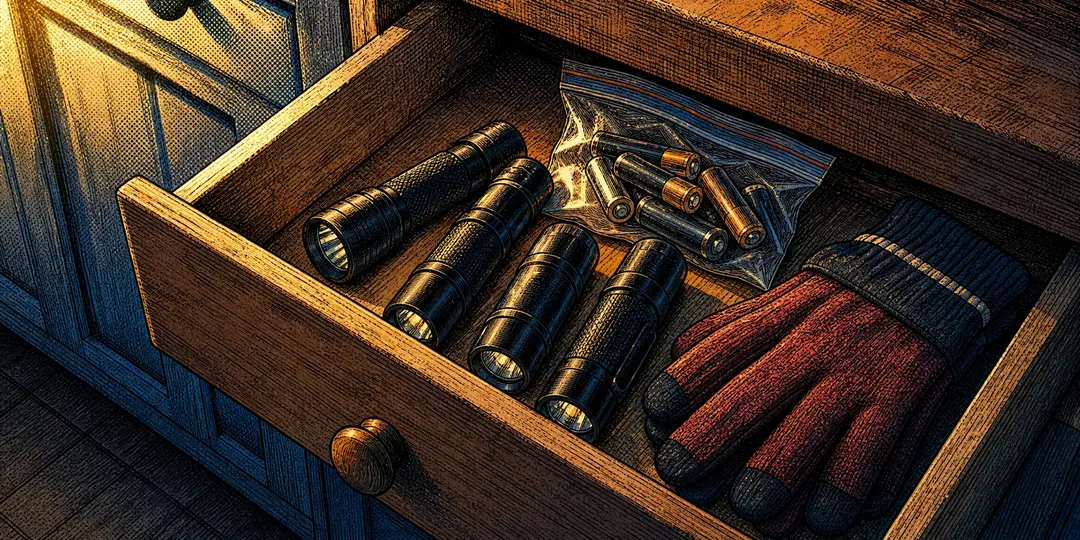
Our recommendation for a family is AA everywhere: the flashlights, the headlamps if you can find good AA ones, and the weather radio. Stock lithium AAs in the emergency tote, because they store for years without leaking and work well in the cold, and use rechargeable NiMH for everyday lights so the batteries get cycled. Take alkalines out of anything that sits in a drawer for months; leaking alkalines destroy more flashlights than drops do.
If you already own 18650 lights and like them, keep them, and keep spare cells charged. Just don’t make a lithium-ion light the only light in the house.
Low mode, switch and the boring details
- A genuine low. Look for a low or “moonlight” mode of 1–20 lumens with a runtime measured in days, not hours. This is the setting you’ll use most.
- A switch that works with gloves. A tail button you can press with a gloved thumb, or a large side switch. Tiny side buttons and multi-click menus are hard in the cold and the dark.
- Simple modes. Ideally it remembers the last mode or starts on low. Lights that start on maximum blind you in a dark hallway.
- Lockout. A way to stop it from switching on in a bag, usually a quarter-turn of the tail or head.
- Tail-standing and a lanyard hole. A light that stands on its tail can bounce off the ceiling and light a room. A lanyard lets you hang it.
Beam: flood or throw
Flood beams spread light widely and evenly. They are what you want indoors, for cooking, in the car and for walking where you need to see your feet. Throw beams focus light into a tight spot that reaches a long way, which is useful for checking the end of the yard or reading a house number from the road, and frustrating in a room.
Most household lights are a compromise: a bright center with a wide, usable spill. If you only buy one style, buy a light with a wide beam or a diffuser cap that turns it into a lantern. For a car or a walk home at night, a moderately focused beam helps you see the road edge.



 4


Comments
No comments yet. Read the comment guidelines before posting.