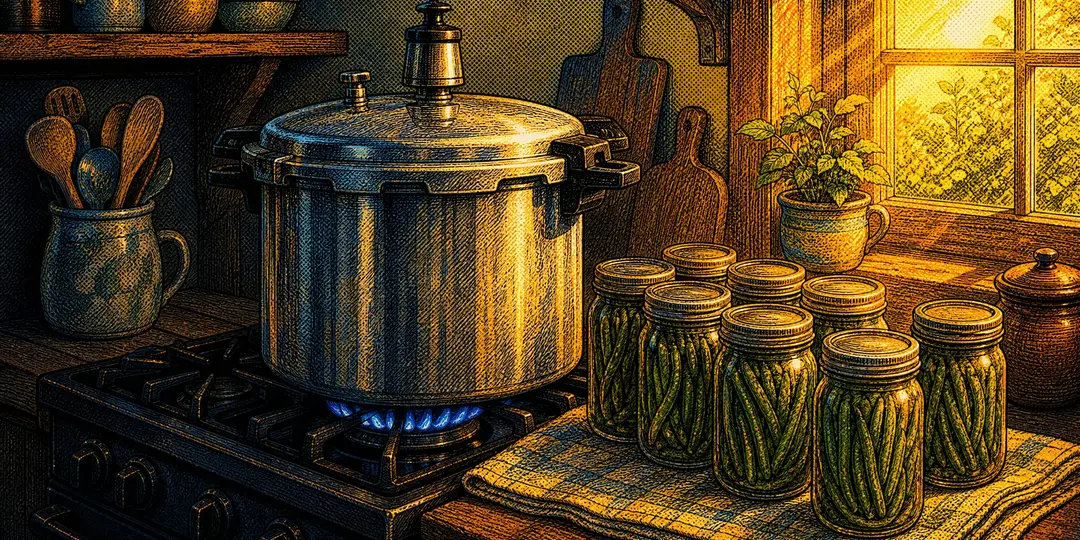
A tall water-bath canner and a heavy pressure canner with a gauge side by side on a stove, jars of peaches and green beans on the counter between them.
Water bath vs pressure canning: which foods need which
Water bath vs pressure canning comes down to pH 4.6. Which side 25 foods fall on, the time each needs, why tomatoes are awkward, and how to check old recipes.
Same jars, different pots. The food decides which one, not the cook.
Water bath vs pressure canning is not a matter of preference. The choice is set by one property of the food: its acidity. Foods with a pH of 4.6 or lower can be safely processed in boiling water. Foods above 4.6 must be pressure canned, because only a pressure canner reaches the 240°F (116°C) needed to destroy botulism spores, and acid is the only thing that stops them from growing at lower temperatures.
Below is the line, the awkward case, a table of 25 common foods, the rules on jars and lids, and why the recipe card in your relative’s handwriting needs checking.
The pH 4.6 line, in plain words
pH measures acidity: the lower the number, the more acidic. Lemon juice is around 2, vinegar around 2.5–3, most fruit 3–4. Plain vegetables, beans, meat, fish and milk sit between 5 and 7.
Clostridium botulinum, the bacterium behind botulism, cannot grow and make toxin at pH 4.6 or below. In a high-acid jar, the boiling water only has to kill molds, yeasts and other spoilage organisms, which 212°F (100°C) does comfortably. In a low-acid jar, botulism spores survive boiling and can grow in the airless, room-temperature conditions a sealed jar provides. Those jars need 240°F, which water only reaches under pressure. Pressure canning for the nervous beginner explains the pressure side in detail.
Two consequences follow. Mixing changes the category: salsa is mostly low-acid peppers and onions held below 4.6 by added vinegar or lime juice, which is why salsa recipes are precise about the ratio. And pickling moves a food across the line: cucumbers, beets and green beans are low-acid fresh but water-bath safe once they are in a tested vinegar brine.
Tomatoes: the awkward case
Tomatoes are usually just under 4.6, but some varieties and some overripe or damaged fruit come out above it, and you cannot tell by taste. Current USDA guidance is therefore to add acid to every jar of tomatoes, whichever method you use: 2 tablespoons of bottled lemon juice or ½ teaspoon of citric acid per quart, and half that per pint. Bottled lemon juice, not fresh, because its acidity is standardized. Four tablespoons of 5% vinegar per quart also works but you will taste it.
Tomatoes can be water-bath canned with that acid, or pressure canned for a shorter time; the USDA guide gives both options for most tomato products. Once you add low-acid vegetables (onions, peppers, mushrooms, meat), it is no longer a tomato recipe; it is a tested sauce or salsa recipe, or it is a pressure-canning recipe.
"You cannot taste pH. Follow the tested recipe, add the lemon juice, and let the method follow the food."
The canning rule, in one line
Water bath vs pressure canning, food by food
Times are for pints–quarts at 0–1,000 ft (300 m), from the USDA Complete Guide to Home Canning and the National Center for Home Food Preservation. They depend on how the food is packed (hot or raw, with or without liquid) and the exact recipe, so treat this as a map, not a recipe: look up the full instructions before you start. Above 1,000 ft, water-bath times go up and pressure canners need more pressure.
Food
Method
Headspace
Time, pints–quarts
Jams and jellies
Water bath
¼ in
5–10 min
Grape or apple juice
Water bath
¼ in
5–10 min
Applesauce
Water bath
½ in
15–20 min
Apple slices
Water bath
½ in
20 min
Peaches
Water bath
½ in
20–30 min
Pears
Water bath
½ in
20–25 min
Berries, whole
Water bath
½ in
15–20 min
Tomatoes, whole or halved (acid added)
Water bath or pressure
½ in
40–85 min water bath, by pack
Crushed tomatoes (acid added)
Water bath or pressure
½ in
35–45 min water bath
Tomato juice (acid added)
Water bath or pressure
½ in
35–40 min water bath
Salsa (tested recipe only)
Water bath
½ in
15–20 min
Dill pickles, quick fresh-pack
Water bath
½ in
10–15 min
Bread-and-butter pickles
Water bath
½ in
10 min
Pickle relish
Water bath
½ in
10 min
Pickled beets
Water bath
½ in
30 min
Sauerkraut
Water bath
½ in
10–25 min, by pack
Green beans
Pressure
1 in
20–25 min
Beets, plain
Pressure
1 in
30–35 min
Carrots
Pressure
1 in
25–30 min
Corn, whole kernel
Pressure
1 in
55–85 min
Potatoes, cubed
Pressure
1 in
35–40 min
Dry beans, soaked
Pressure
1 in
75–90 min
Meat or poultry stock
Pressure
1 in
20–25 min
Chicken, boneless
Pressure
1¼ in
75–90 min
Ground or cubed beef
Pressure
1 in
75–90 min
Some foods have no safe home-canning process at all, so freeze or dry them instead: pumpkin or squash purée and pumpkin butter (cubes are fine, pressure canned), dairy, eggs, flour- or cream-thickened soups and sauces, and pasta or rice in a jar. Anything that says “can it in the oven” or “just turn the jar upside down” is not a method.
High-acid on top, low-acid below. Two shelves, two methods; the labels carry the date and nothing else needs remembering.
Running a water bath
A water-bath canner is any pot deep enough to hold jars on a rack with 1–2 inches of water above the lids and room to boil. A purpose-made canner costs $25–50; a tall stockpot with a rack works. Fill, heat, load hot jars, top off so the jars are covered by at least an inch, and start timing only when the water is at a full rolling boil. Keep it boiling the whole time. When the time is up, turn off the heat, take the lid off, wait five minutes, then lift the jars straight up onto a towel and leave them for 12–24 hours.
Atmospheric steam canners, which use a few inches of water and steam instead of a full pot, are now accepted by NCHFP for high-acid foods with tested water-bath times of 45 minutes or less, if used as the maker and NCHFP direct. They are not pressure canners and cannot do low-acid food.
Jars, lids and what can be reused
Jars: canning jars are reusable for years if the rim has no chips and the glass no cracks. Run a finger around the rim every time.
Bands (screw rings): reusable until they rust or bend. Take them off for storage once jars have sealed, so a failed seal shows.
Flat lids: single use. The sealing compound is designed to seal once. Reusable lid systems exist; if you use one, follow its maker’s instructions exactly.
Commercial food jars (mayonnaise, pasta sauce, coffee): the USDA guide advises against them. The glass may be thinner, the threads may not fit a canning lid, and they break more often, especially in a pressure canner.
Old jar styles: bail-wire jars with rubber rings and zinc caps are no longer recommended for canning. Keep them for dry goods.
Why old family recipes need checking
The recipe card from a grandparent is often the reason people start canning, and it deserves respect, but many predate the current USDA tested processes. Common problems in older recipes:
Tomatoes with no added acid, from before acidification became standard advice.
Open-kettle canning: hot food into jars, lid on, no processing. It seals, but it is not safe.
Water-bath times for low-acid vegetables, sometimes for hours, which still never reach 240°F.
Paraffin wax on jam, inverting jars to seal, oven or dishwasher “canning,” and aspirin as a preservative.
Thickened or mixed recipes (soups with flour, chili with beans and pasta) with a time guessed from a similar food.
The fix is not to throw the recipe away. Find the closest tested recipe in the USDA guide or on the NCHFP site and use its method, time and acid; keep the family seasoning. If there is no tested equivalent, freeze it or make it fresh. Both sources are free and kept up to date, and your county extension office can answer questions and test dial gauges.
Quick answers
Can you water bath can green beans?
No. Plain green beans must be pressure canned. Like other plain vegetables they are low-acid, above pH 4.6, and boiling water at 212°F (100°C) does not destroy botulism spores; only a pressure canner reaches the 240°F (116°C) needed. Green beans become water-bath safe only when they are pickled in a tested vinegar brine recipe.
Do you need to add lemon juice when canning tomatoes?
Yes. USDA guidance is to add 2 tablespoons of bottled lemon juice or ½ teaspoon of citric acid per quart of tomatoes, and half that per pint, whether you water-bath or pressure can them. Some tomatoes come out above pH 4.6 and you cannot tell by taste. Use bottled lemon juice, not fresh, because its acidity is standardized.
Which foods can be water bath canned?
High-acid foods at pH 4.6 or below can be water-bath canned: jams and jellies, fruit juices, applesauce, peaches, pears, berries, pickles, relish, pickled beets, sauerkraut, tested salsa recipes, and tomatoes with added acid. Plain vegetables, dry beans, meat, poultry and stock need a pressure canner. Take the time and headspace from a tested USDA or NCHFP recipe.
Can you reuse canning lids and jars?
Canning jars can be reused for years if the rim has no chips and the glass has no cracks, and bands can be reused until they rust or bend. Flat canning lids are single use, because the sealing compound is designed to seal once. The USDA guide advises against canning in commercial mayonnaise or pasta sauce jars.
Is it safe to use an old family canning recipe?
Only after checking it against a current tested recipe. Many older canning recipes predate USDA tested processes and use unsafe methods such as open-kettle canning, tomatoes with no added acid, or water-bath times for low-acid vegetables. Take the method, time and acid from the closest tested recipe in the USDA guide or on the NCHFP site, and keep the family seasoning.
The books this guide recommends. Most libraries have them too. As an Amazon Associate we earn from qualifying purchases, at no cost to you. Prices and availability are accurate as of the date and time shown and are subject to change. The price and availability shown on Amazon.com at the time of purchase will apply.
USDA
Complete Guide to Home Canning (USDA)
The USDA's tested processes, times and headspace for each food, the source behind the guide's table.
$16.99 on Amazon as of Nov 24, 7:06 a.m. CT
Good to know: The full guide is also free on the NCHFP website.
Picks that match the specs in this guide, from makers with a track record. We haven't tested them yet. As an Amazon Associate we earn from qualifying purchases, at no cost to you. Add what you need to my list, then send the whole list to your Amazon cart all at once. Prices and availability are accurate as of the date and time shown and are subject to change. The price and availability shown on Amazon.com at the time of purchase will apply.
Presto
Presto 01781 23-Quart Pressure Canner and Cooker
Stovetop 23-quart canner with dial gauge, holds 7 quart jars, well above the four-jar minimum.
No price from Amazon right now (checked Nov 24, 7:06 a.m. CT)
Good to know: Have the dial gauge tested every year; many county extension offices do it free.
Shane is a disabled US Army veteran who served as an M1A1 tank crewman, then spent his career in technology and manufacturing supply chains, keeping parts moving through COVID. He, his wife Heather and their three kids have ridden out tornadoes, the February 2021 Texas freeze, the 2026 floods in Northeast Texas and power outages that lasted days. He started Prepping Expert to give families the plain, affordable, step-by-step version he wished he'd had.
Three rules pick what goes on our deals list, and the same three show how to spot a fake discount: an inflated “was” price, a countdown or a bargain that isn’t.
We use Google Analytics cookies to count visits and see which guides help. No ads, nothing sold. Cookie policy






 4
Comments
No comments yet. Read the comment guidelines before posting.