


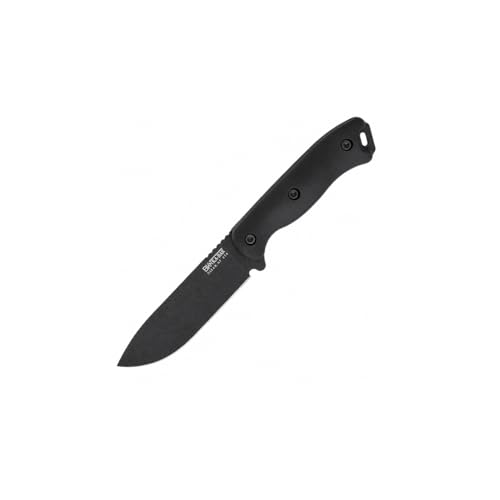
To choose a survival knife, buy one fixed blade with a blade of four to five inches (10–13 cm), about an eighth of an inch (3–4 mm) thick, with a full tang, a simple steel you can sharpen, and a sheath that holds it when you turn it upside down. Expect to pay $40–80. That knife will split kindling, cut cord, open packaging, prepare food at a campsite and do the odd jobs an outage throws at you, and it will last decades if you keep it dry and sharp.
Everything else on the shelf is a variation on that, and most of the variations are for looks. This guide translates the jargon on the box so you can pick one knife and stop.
What a household actually uses a knife for
Be honest about the jobs before choosing the tool. For a family preparing for outages, storms and the odd camping trip, the list is short:
- Cutting cord, tape, zip ties, packaging and fabric
- Splitting small pieces of firewood into kindling and making feather sticks for a fire
- Food preparation at a campsite or on a grill when the kitchen is dark
- Opening, scraping and prying light things, within reason
What is not on the list: chopping down trees (that is an axe or a saw), self-defense, or anything you have seen on a survival show. A bigger knife is not a better knife for any of the jobs above; it is just harder to control and harder to carry legally.
How to choose a survival knife: blade length, thickness and tang
| Feature | What to look for | Why |
|---|---|---|
| Blade length | 4–5 in (10–13 cm) | Long enough to baton through wrist-thick wood, short enough for fine work. Under 3.5 in struggles with splitting; over 6 in gets clumsy for food and cord. |
| Thickness (spine) | About 1/8–5/32 in (3–4 mm) | Thick enough to survive batoning, thin enough to slice. Quarter-inch (6 mm) slabs split wood well and cut everything else badly. |
| Tang | Full tang | The steel runs the full length of the handle, so the handle can’t snap off at the joint under load. |
| Spine | Square, sharp-cornered | A square spine scrapes a ferro rod and makes fine shavings for tinder; a rounded one doesn’t. |
| Edge | Plain, no serrations | Serrations are hard to sharpen at home and snag in wood. A plain edge does it all. |
A note on tang: some well-regarded budget knives use a partial (“rat-tail” or three-quarter) tang and survive years of use. A full tang is the safer default when you can’t inspect how the knife is built, and at $40–80 it is easy to find.
Steel: stainless, carbon, and the three that matter at this price
Knife steel is a trade-off between hardness (holds an edge longer, but harder to sharpen and more likely to chip), toughness (bends or survives impact rather than chipping) and corrosion resistance. In the $40–80 band, you will mostly see three families, and all three are fine.
1095 and similar high-carbon steels. Simple, tough, takes a very keen edge and comes back easily on a stone. It rusts, sometimes overnight in a damp sheath, which is why many 1095 knives come with a coating on the blade. Good for someone who will wipe and oil it.
Sandvik 12C27 and 14C28N. Swedish stainless steels that sharpen almost as easily as carbon steel and shrug off a damp sheath far better. 14C28N is the newer and slightly better one. A sensible default for a knife that will sit in a kit for months between uses.
8Cr13MoV, AUS-8 and similar budget stainless. Common on cheaper knives. Softer, so they lose their edge sooner, but they are easy to sharpen and resist rust well. Fine for a household that uses the knife a few times a year.
You will also see premium “powder” steels on knives above $100. They hold an edge much longer and are a pleasure to own, and they are not what stands between a household and a bad week. Heat treatment matters more than the steel’s name, which is the main reason to buy from an established maker rather than an unbranded listing.
Grinds, one paragraph each
The grind is the shape of the blade in cross-section, from spine to edge. It decides how the knife cuts.
Scandi grind. One wide flat bevel on each side running straight to the edge, with no secondary bevel. It bites into wood well, makes feather sticks easily and is the easiest grind to sharpen on a flat stone because the bevel tells you the angle. Common on Scandinavian-style bushcraft knives and a good first choice.
Flat grind. The blade tapers evenly from the spine (or partway down) to a small edge bevel. It slices well, particularly food, and is a good all-purpose grind. Slightly harder to sharpen evenly than a Scandi.
Saber grind. The flat taper starts partway down the blade, leaving a thicker, stronger upper section. It is tougher under batoning and prying but slices less well. Common on heavier “survival” knives.
Hollow grind. The bevel is concave, as if ground on a wheel. It produces a very thin, sharp edge that slices beautifully and is weaker under side loads. Better for hunting and kitchen use than for splitting wood.
Convex grind. The bevel bulges slightly outward, like an axe. Very strong and durable, but harder to maintain on a flat stone without practice. Leave it for a second knife.
Handle and sheath
Handle. Pick a handle you can hold firmly with wet or gloved hands: textured rubber, micarta or G-10 composites, or plain wood. Avoid shiny, hard plastic and deep finger grooves that only fit one hand size. Hold it if you can; a knife that bites into your palm after ten cuts won’t get used.
Sheath. The sheath matters as much as the blade. It should hold the knife securely when shaken upside down, protect the edge from cutting through, and drain water rather than trapping it. Molded plastic sheaths are cheap, tough and drain well. Leather looks good and traps moisture against carbon steel. Nylon is fine if it has a plastic liner. If the sheath is poor, budget $20–40 to replace it.
Price bands, and why $40–80 is enough
| Price band | What you get | Who it suits |
|---|---|---|
| $15–40 | Some genuinely good knives from established makers, often with a simpler sheath or partial tang; plenty of poorly heat-treated junk too | A kit knife, a second knife for the car, a teenager’s first knife |
| $40–80 | Full tang, a known steel with decent heat treatment, a usable sheath, reliable quality control | Almost every household. Buy here. |
| $80–150 | Better steels, nicer handles, better fit and finish | Someone who uses a knife weekly and enjoys owning a good one |
| $150+ | Premium steels, custom makers, collector appeal | Enthusiasts. Not a preparedness purchase. |
At the low end, buy from a maker you have heard of. Unbranded knives with dramatic shapes and no named steel are where the chipped edges and snapped handles come from. Check the current price; the bands drift. What the cheaper end offers, and what to check before buying, is in fixed-blade knives under $60.
The law: check before you carry
Owning a fixed-blade knife at home is legal almost everywhere in the US. Carrying it is where the rules differ, and they differ a lot: blade-length limits, rules on concealed versus open carry, and city ordinances that are stricter than the state’s. Transporting a knife in a car, onto school property, into a government building or across state lines all have their own rules.
We can’t give legal advice, and the rules change. Start with knife carry laws by state and the wider self-defense and weapons laws by state, then check your state’s statutes or ask a local attorney if you plan to carry a fixed blade anywhere but a campsite. For a household kit, the simplest legal answer is usually to keep the fixed blade at home or in the camping gear, and carry a small folder within your local limit.
Keeping it sharp and dry
A dull knife is more dangerous than a sharp one because it needs force and slips. Sharpening is a skill you can learn in an afternoon.
- Buy a combination whetstone (a coarse side and a fine side, $15–35) or a simple pull-through guided sharpener if you will never practice. A stone gives a better edge and lasts longer.
- Hold the angle. On a Scandi grind, lay the bevel flat on the stone and push the edge forward. On other grinds, hold roughly 20 degrees and keep it steady; a marker line on the bevel shows you where you are removing metal.
- Strop or hone between sharpenings. A few passes on a leather belt or a ceramic rod keeps the edge going for weeks.
- Dry it after use and oil carbon steel. A drop of food-safe mineral oil wiped along the blade stops rust. Don’t store a knife in a leather sheath for months; keep it beside the sheath in a dry drawer.
- Never put it in the dishwasher. The heat and detergent dull the edge and damage handles.
Once you have the knife, learn to use it with cord: six knots that cover 95% of what you’ll ever tie and a few hanks of paracord and bank line are the natural next purchases.
Quick answers
What size survival knife is best?
A blade of 4–5 inches (10–13 cm), about 1/8 inch (3–4 mm) thick, with a full tang. That is long enough to baton through wrist-thick wood and short enough for food and cord. A survival knife under 3.5 inches struggles with splitting, and one over 6 inches gets clumsy for fine work and harder to carry legally.
Is carbon or stainless steel better for a survival knife?
Neither wins outright. High-carbon steel such as 1095 is tough and easy to sharpen but can rust overnight in a damp sheath, so it suits someone who wipes and oils the blade. Stainless steels such as Sandvik 14C28N sharpen almost as easily and forgive neglect, which makes them a sensible default for a knife that lives in a kit.
How much should a survival knife cost?
About $40–80 buys a full-tang knife with a known steel, decent heat treatment and a usable sheath, which is enough for almost every household. Above roughly $80 you pay for better steels, handles and finish rather than usefulness. Below $40, buy only from an established maker, because unbranded knives are where chipped edges and snapped handles come from.
Is it legal to carry a fixed-blade knife?
It depends on your state and city. Owning a fixed-blade knife at home is legal almost everywhere in the US, but carry rules vary widely, with blade-length limits, concealed and open carry rules, and city ordinances stricter than the state’s. This is not legal advice; check your state’s statutes or ask a local attorney before carrying one anywhere but a campsite.
Read next
Fixed-blade knives under $60: what you get and what to check. The cheaper end of the market, judged against the criteria on this page.



 4


Comments
No comments yet. Read the comment guidelines before posting.