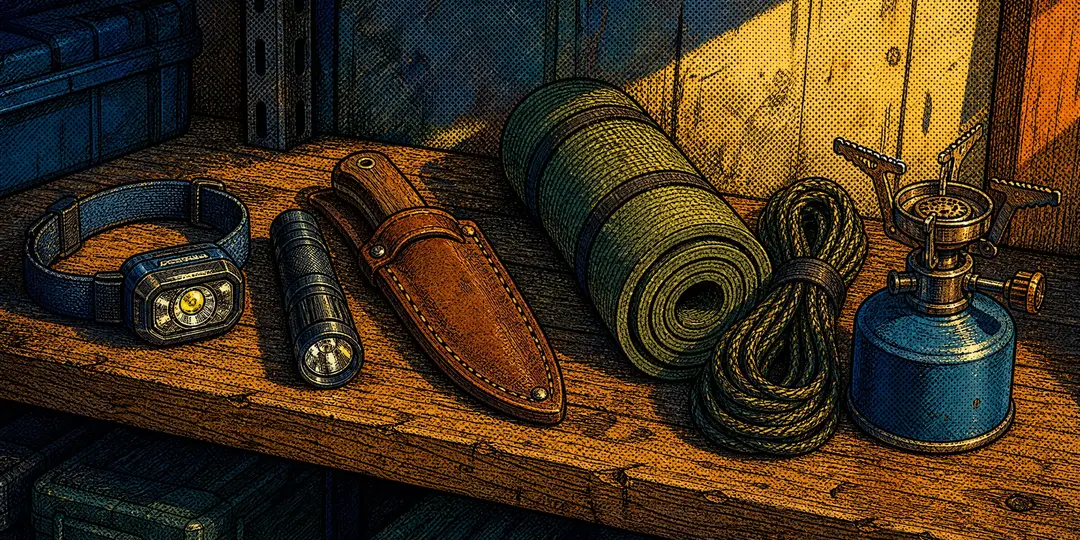
A garage workbench with flashlights, a folded backpack, a camp stove and a fixed-blade knife beside a notebook, a kitchen scale and a pile of receipts, in daylight.
How we test gear for every review: we pay retail, use it for a stated period in the conditions it’s sold for, and break it where that’s safe. The rules in full.
Shane RichardOct 16, 20268 min readGuide · Complete guide
The bench where reviews start: the gear, the receipts, the scale and the notebook the results go into.
A review is only worth reading if you know how it was made. On this site that means four rules: we buy the thing at retail, we use it for a stated period in the conditions it is sold for, we test to failure where that is safe, and we tell you about any money that changes hands afterward. This page sets out how we test gear: those rules, what our verdicts mean, and the basic protocol for each kind of gear we review, so you can judge every review against them.
It is also a promise you can hold us to. If a review on this site breaks one of these rules, tell us through the contact page and we will correct it in public. The wider standards that cover everything we publish, not just reviews, are on the editorial policy page.
How we test gear: the four rules
1. We buy retail. Every review unit is bought from an ordinary store or website at the price you would pay, with our own money, and we keep the receipt. We do not accept free samples, long-term loans or “review units” from manufacturers, even when they are offered with no strings. A unit picked by the brand for a reviewer is not the unit you will get in the mail.
2. We disclose affiliate links. Some links on review pages earn us a commission if you buy through them. That is how the site pays for the gear. The commission is the same whether a product gets “buy” or “avoid,” we link to products we tell you to avoid when it helps you recognize them, and no brand sees a review before it is published. The details are on the affiliate disclosure page.
3. We use it for a stated period. Every review says how long the gear was used, where and how: “three weekends and one five-day outage,” not “extensively tested.” The period has to match the claim. A sleeping bag sold for winter gets a winter. A knife sold for camp chores does camp chores, not a photo shoot. If the period is short, we say so and say what that leaves unknown.
4. We test to failure where it is safe. Gear fails at the end of its life, at the worst moment, and the useful question is how. So once the normal-use period is over, we try to break it: drops onto concrete, switch cycles, wet-and-freeze cycles, seams loaded until they go. We stop short of anything that risks a person, such as overcharging a lithium battery, pressure-testing a stove past its rating, or anything a manufacturer warns would cause a fire.
"We pay for it, we use it the way you would, then we find out how it breaks."
The testing policy, in one line
What a verdict means here
Every review ends with one of three verdicts, and each verdict says who it is for. We do not use star ratings or scores out of 100, because a 7.8 tells you nothing about whether to spend $40.
Verdict
What it means
What you should do
Buy
We would spend our own money on it again for the job named in the review.
Buy it if that job is yours. Check the current price; the band we quote may have moved.
Fine
It works and nothing went wrong, but something else does the same job better or cheaper.
Keep it if you own it. Don’t replace it. If you’re buying new, read the "buy" pick first.
Avoid
It failed at its main job, failed unsafely, or costs far more than a better option.
Don’t buy it. If you own it, the review says what to watch for or what to replace it with.
A verdict applies to the version we bought. Manufacturers change parts, steels and batteries without changing the product name, which is why every review lists the date and the place we bought it.
Updates and corrections
Gear keeps being used after the review is published, and some of it fails later. When that happens we update the review, change the verdict if the failure deserves it, and add a dated note at the top of the page saying what changed and why. We do not quietly edit old verdicts. If we got a fact wrong, the correction is dated and stays on the page. Once a year the products we would still buy go on gear that lasts: the buy-once list, along with the ones that dropped off and what replaced them.
Who does the testing, and where
The testing happens in ordinary places: a three-bedroom house, a garage, a car, a backyard, a few state-park campsites, and the commute. That is deliberate. Our readers will use this gear in a dark kitchen during an outage, not on an expedition, and a light that is excellent on a mountain but awkward to work with gloves in a cold garage is not excellent for them.
We write down the conditions as we go: the air temperature, how long, what went wrong and when. Where a result can be measured, we measure it with cheap, common tools anyone could repeat, such as a kitchen scale, a phone stopwatch, an inexpensive light meter and an indoor-outdoor thermometer. Where it can’t be measured, such as how a pack feels after three miles, we say it is a judgment and whose.
The standard protocols, by category
Each review states its own protocol, but the core of each category stays the same so you can compare reviews against each other.
Category
Normal-use period
What we measure
How we try to break it
Flashlights and headlamps
At least one month of household use, or one winter for cold claims
Runtime on high and low against the claimed ANSI FL1 figures, with the battery type stated; whether low is genuinely low
Repeated drops onto concrete from about 1 m; a few thousand switch clicks; a soak in a bucket if water resistance is claimed
Bags and packs
Carried loaded to the weight we recommend, on real walks and commutes
Empty and loaded weight; how the hip belt and shoulder straps hold up after a few miles
Overloading, dragging across concrete, zipper cycles, a rain test with a stated amount of water
Stoves
Used for real meals over several weekends and at least one cold morning
Time to boil a quart (about 1 L) of water, fuel used per boil, how it behaves in wind
Cold starts, repeated assembly and disassembly; never anything past the maker’s safety limits
Knives
Camp and kitchen chores over several weekends
Edge retention after a stated number of cuts; how easy it is to bring back to sharp
Batoning through seasoned wood, a salt-water rust test, prying only where the maker allows it
Other categories, such as sleeping pads, radios and water filters, follow the same pattern: a real-use period, a few measurements anyone could repeat, then a careful attempt to find the failure. The review says so when a protocol differs from this table and explains why.
The drop test is unglamorous: a mark on the wall, a concrete floor, a notebook and a count of how many drops before something rattles.
What we don’t do
Some things are common in gear reviews and absent from ours.
No unboxing reviews. If we haven’t used it for the stated period, there is no review, only a note that we bought it.
No lab claims we can’t back. We don’t own an integrating sphere or a climate chamber. When a measurement needs one, we say the maker’s figure is the maker’s figure.
No “best overall” for everyone. The verdict names who it is for. A family of five in a cold state and a single commuter need different lights.
No tactical cosplay. Gear that looks good in black but does the household job badly gets an honest verdict.
No reviews of things we tell you not to buy yet. If an item isn’t worth owning before the basics are done, we say so instead of reviewing six versions of it.
How to use our reviews
Start with the buying guide for the category, which explains what to compare and what the numbers on the box mean. Named picks are added to each guide only once a product has been through the process above; until then the guides tell you what to look for, not which box to buy. The flashlight buyer’s guide and choosing a survival knife are good examples. If you only want the short version, gear that lasts: the buy-once list is the place to look.
And remember the order. Water, food, light and a plan come before any of the gear on this site; the first 30 days sets out that order.
Quick answers
Does Prepping Expert accept free gear for review?
No. Under Prepping Expert’s testing policy, every review unit is bought at retail from an ordinary store or website, at the price a reader would pay, with the site’s own money, and the receipt is kept. The site does not accept free samples, long-term loans or manufacturer “review units,” because a unit picked by the brand is not the one a reader gets.
What do the buy, fine and avoid verdicts mean?
Prepping Expert reviews end with one of three verdicts instead of scores. “Buy” means the reviewer would spend their own money on it again for the named job. “Fine” means it works, but something else does the job better or cheaper. “Avoid” means it failed at its main job, failed unsafely, or costs far more than a better option.
Do affiliate links affect Prepping Expert’s reviews?
No. Some review links earn Prepping Expert a commission, which pays for the gear, but the commission is the same whether a product gets “buy” or “avoid,” and no brand sees a review before it is published. Affiliate links are disclosed on the page, and the full policy is on the site’s affiliate disclosure page.
How long is gear used before it is reviewed?
Every Prepping Expert review states how long the gear was used, where and how, and the period has to match the claim being tested. Flashlights and headlamps, for example, get at least one month of household use, or one winter for cold-weather claims. If the period is short, the review says so and says what that leaves unknown.
What happens if reviewed gear fails after the review?
The review is updated. If gear fails after publication, Prepping Expert changes the verdict where the failure deserves it and adds a dated note at the top of the page saying what changed and why. Old verdicts are never quietly edited, and corrections of fact are dated and stay on the page.
Printable
Gear inventory checklist (PDF, 1 page). What you own, where it lives, when you last tested it, with a line for the battery type.
Shane is a disabled US Army veteran who served as an M1A1 tank crewman, then spent his career in technology and manufacturing supply chains, keeping parts moving through COVID. He, his wife Heather and their three kids have ridden out tornadoes, the February 2021 Texas freeze, the 2026 floods in Northeast Texas and power outages that lasted days. He started Prepping Expert to give families the plain, affordable, step-by-step version he wished he'd had.





 4

Comments
No comments yet. Read the comment guidelines before posting.