


The fastest way to lose your family on preparedness is to start with the disaster. The fastest way to win them is to start with the last thing that actually went wrong: the three days without power in February, the boil-water notice last summer, the afternoon the school closed early and nobody could reach anyone. Everyone in the house remembers it, nobody has to imagine anything, and the obvious question follows on its own: what would we do differently next time?
This guide is the practical version of talking to family about prepping: what to say, to whom, in what order, and what to leave out. It assumes you already care about this and someone else in the house doesn’t yet.
Talking to family about prepping: lead with what happened
A scenario asks the other person to accept a premise before they can engage with it. A recent local event doesn’t. Compare two openings:
- “What would we do if the grid went down for a month?”
- “Remember when the power was out for three days in February? I’d like us to not do that again with no flashlights and a dead phone.”
The first invites an argument about whether the grid will go down. The second invites agreement, because it already happened and it was miserable. It also sets the scale correctly: a few days, a storm, an outage, a closed road. That is what most preparedness is for, and it is what which emergencies actually apply to where you live says should come first.
If nothing comes to mind, use the house: “If there were a fire tonight, where would we all meet outside?” Smoke alarms and fire drills are already normal. Preparedness is the same idea, extended by a few days.
Conversation one: your partner (money and space)
Partners rarely object to preparedness itself. They object to what it might cost, where it will go, and what it says about the person proposing it. Answer those three directly before they are raised.
Money. Put a number on it and a limit. “I’d like to spend about $300 over the next month on water, a pantry and a few flashlights, and then it’s maintenance.” A defined, modest budget is easy to agree to. An open-ended project is not. If money is tight, the $25-a-week buying order spreads the same list over three months.
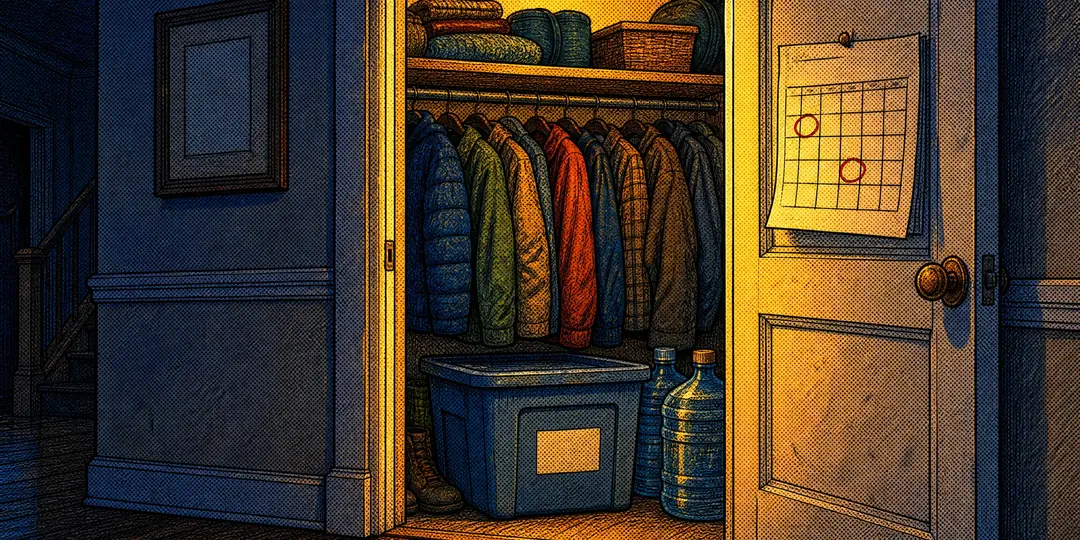
Space. Say exactly where things will go. “One tote in the hall closet, water jugs under the bed in the spare room, and the pantry stays the pantry, just fuller.” Partners who imagine the garage turning into a warehouse will resist; partners shown a single closet usually won’t.
Identity. Make it clear this is a household chore, not a new personality. You are not joining a movement or changing how you talk at dinner parties. The calm, boring, consistent version of prepping is a useful thing to share here, because it argues for exactly that.
Then ask for one thing, not ten. The best first ask is usually the paperwork: copies of IDs, insurance and prescriptions in one place. It is hard to argue with, it takes an evening, and it is the thing you will be most glad to have in an evacuation.
If your partner still isn’t interested, that is common and workable. Prepping with a partner who isn’t interested covers what you can do on your own without making it a fight.
Conversation two: the kids (the meeting point)
Children need a small number of concrete facts, delivered calmly, and they need to practice them. They don’t need the reasons in detail, and they should never be told about scenarios that frighten adults.
What to cover depends on age:
| Age | What they need to know | How to make it stick |
|---|---|---|
| Under 6 | How to get out of the house if the alarm goes off; your full name and phone number; where to meet outside | A fire drill once or twice a year, treated as a game; a card with your number in their backpack |
| 6–11 | The meeting point near home and the one farther away; who is allowed to pick them up from school; where the headlamps are | Walk to both meeting points once; let them own their headlamp and check its batteries |
| 12 and up | The whole family plan: meeting points, the out-of-town contact, where the kit is, how to turn off the water | Give them a job in the plan, such as checking on a neighbor or charging the power banks monthly |
FEMA’s family planning guidance suggests two meeting places: one right outside the home for a fire, and one outside the neighborhood in case you can’t get back. It also suggests an out-of-town contact, because during a local emergency a text to someone in another state often gets through when local calls don’t. Both translate well for children: “If we can’t find each other, everyone texts Aunt Sarah.”
Keep the tone flat and practical. “This is like knowing where the fire exit is at school” works. Anything about bad people, shortages or the world ending does not. If a child asks a frightening question, answer the narrow version honestly (“Storms sometimes knock the power out for a few days; that’s why we have headlamps”) and stop there.
Conversation three: older parents (medication and who checks in)
Older parents are often the most practically exposed members of the family and the most resistant to being told what to do. Frame it as a favor to you: “I’d worry less if I knew…” works far better than “You need to…”.
Three things to cover:
- Medication. How many days’ supply do they have on hand? Does anything need refrigeration? Is there a powered device, such as oxygen or a CPAP, that stops working in an outage? These are the questions that decide whether a four-day outage is an inconvenience or a hospital visit. Their pharmacist and doctor are the right people to ask about extra supply; the 90-day medication buffer explains the legal routes.
- Who checks on them. Name one person, by name, who will call or visit within a day of any outage or storm. If you live far away, that is a neighbor or a local relative, and they should know they’ve been named.
- Where they would go. If their house is too hot, too cold or has to be left, where do they go and how do they get there? A relative’s spare room, a friend’s house, the county’s cooling or warming center. Write it down.
Some utilities run programs for customers who depend on powered medical equipment; it is worth asking theirs. Preparedness for older parents has the full checklist to work through with them.
What not to say
Some phrasing reliably ends the conversation. Avoid:
- Timelines. “Within the next five years…” Nobody knows, and it makes you sound like you are predicting.
- Collapse, grid-down, the end of anything. These words put you in a category in the listener’s mind, and you will not get out of it that evening.
- Anything that requires fear first. If your argument only works once the other person is scared, it is the wrong argument. The good ones work on someone who is perfectly calm: we lost power, it was bad, a few cheap things would have fixed it.
- Gear first. Leading with a purchase invites a debate about the purchase. Lead with the gap.
- Volume. One topic per conversation. A single dinner covering water, food, radios, documents and evacuation routes is a lecture.


 4


Comments
No comments yet. Read the comment guidelines before posting.