


A ferro rod that throws sparks but won’t light anything is almost never a bad rod. It is one of five problems, usually two at once: a scrape that is too fast and too light, a coating that hasn’t been removed, tinder that is too coarse, wind, or a technique that knocks the tinder apart. Each has a simple fix. Below is how to use a ferro rod properly, taking the failures in the order they usually happen, then a practice drill with a time target.
If you haven’t built fires with a lighter yet, start with fire starting from scratch. A ferro rod only replaces the lighter. The tinder, kindling and fuel ladder still decide whether the fire survives.
How a ferro rod actually works
Ferrocerium is a man-made alloy that sheds tiny particles when scraped with something harder and sharp-edged. Those particles ignite in the air as sparks, burning at around 3,000 °F (about 1,650 °C). The sparks are very hot but tiny and short-lived. That’s the whole trick: you are not lighting tinder with a flame, you are dropping a shower of very small, very hot particles onto material fine enough to catch from them.
Everything below follows from that. More particles, landing in one place, on finer tinder, out of the wind.
Failure 1: the scrape is too fast, too light, at the wrong angle
What it looks like: a few thin sparks that scatter, or a pretty spray that lands everywhere except the tinder.
The fix: slow down and press harder. Hold the striker at about 45 degrees to the rod, with firm pressure, and draw it along the full length of the rod in one controlled stroke, as if peeling a thin layer off. You want a thick, heavy shower of sparks, not a flick. A fast, light flick looks dramatic and lights nothing.
If you are using a knife instead of a striker, use the spine, never the edge, and check that the spine has a sharp, square corner. Many knives have a rounded or painted spine that won’t throw sparks at all. That’s not your fault; it is the knife.
Failure 2: the coating is still on the rod
What it looks like: a new rod produces almost nothing, however hard you scrape.
The fix: many rods ship with a black protective coating to stop corrosion. It has to be scraped away before the rod will spark well. Spend a minute scraping one section with the striker until bright metal shows, then use that section. The rod will look scuffed and gray after this. That’s normal.
Failure 3: the tinder is too coarse
What it looks like: sparks land right on the tinder, glow for a moment and die.
The fix: make it finer and fluffier. Sparks light the thinnest fibers, then those light the rest. Tinder that catches easily from a lighter may not catch from a ferro rod.
What works, roughly from most to least forgiving:
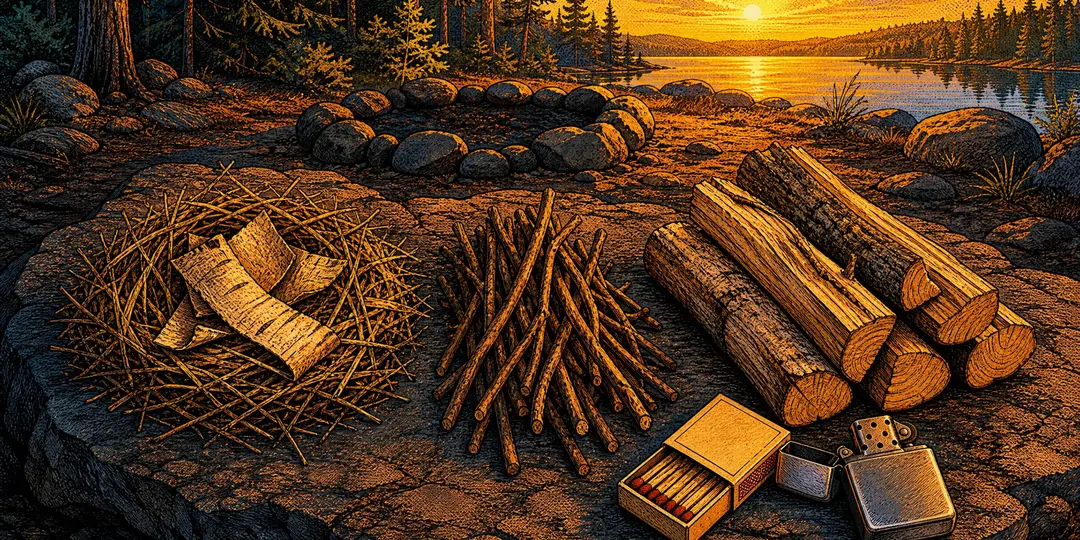
- Cotton balls with petroleum jelly, pulled apart so the dry fibers stick out. This is the one to practice with.
- Commercial tinder tabs, scraped or torn to expose fluffy fiber.
- Jute twine, unraveled and fluffed into a loose ball.
- Fatwood, scraped into a small pile of fine dust and shavings.
- Birch bark, scraped to a fine powder and thin curls.
- Dry grass, rubbed between your palms until it is fiber, with the finest material in the center of the nest.
A ferro rod will not light a bundle of twigs, a pine cone or a thick wood shaving. Those come next on the fuel ladder, not first.
Failure 4: striking into the wind
What it looks like: sparks blow sideways and the tinder never catches, or catches and is blown out.
The fix: put your back to the wind, kneel close, and use your body as the windbreak. Make a small wall of your pack or a log on the windward side. Get the tip of the rod into or right against the tinder so the sparks travel a short distance. In strong wind, light a piece of carried tinder in a sheltered spot, then move it into the lay.
Failure 5: moving the wrong hand
What it looks like: the striker hits the tinder at the end of the stroke and scatters it, or the rod tip wanders and the sparks land somewhere new each time.
The fix: keep the sparks landing in one place by keeping the striker still and moving the rod instead. Put the tip of the rod in the tinder. Brace your striker hand against your knee or the ground, with the striker on the rod at 45 degrees. Then pull the rod back and up, toward you, against the fixed striker. The sparks land exactly where the rod tip was, and the tinder stays where you built it.
Plenty of people strike the conventional way, pushing the striker down the rod, and it works fine once the scrape is controlled. But pushing the striker is what knocks tinder apart, and switching hands is the quickest cure for beginners who keep scattering their tinder.



 4
Comments
No comments yet. Read the comment guidelines before posting.