


For an ordinary household, the answer is short. A pocket-sized canister of pepper spray, carried by the adults who want one and practiced with an inert trainer, is the non-lethal tool that earns its place. On pepper spray vs taser, stun devices are a distant second with real limits. Body armor is legal for most people and useful for a few, but for a family in a normal house it comes after the door locks, the outside lights and a working phone plan, which is to say much later.
None of these replaces the first layer, which is not being there. Self-defense for ordinary people: avoidance first is the place to start if you haven’t. This guide covers what each tool does, what the law broadly says, and what we would actually buy. It is general information, not legal advice; the law section points you to who can give that.
Pepper spray: what it does and what it doesn’t
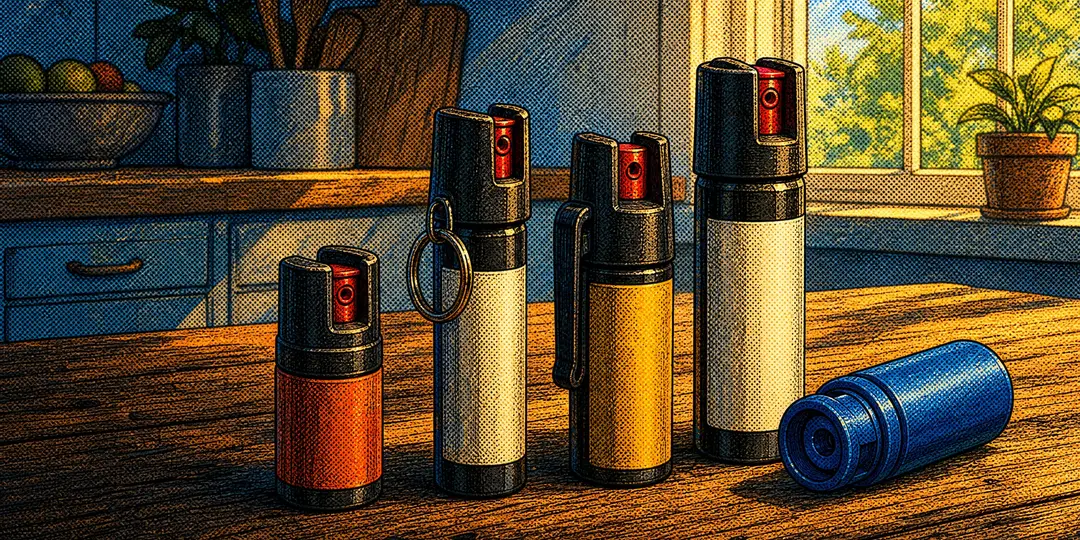
Pepper spray is oleoresin capsicum (OC), the oily extract of hot peppers, in a pressurized canister. It inflames the eyes, nose and throat: the eyes close involuntarily, breathing feels difficult, the skin burns. The point is not to win anything; it is to buy a few seconds to leave.
Police use of force reviews have long found OC effective in most uses and unreliable in a minority. The people it works least well on are the ones you would most want it to stop: someone very intoxicated, in a mental-health crisis, or past the point of feeling pain. Plan on it as a way to create distance, never as a guarantee.
The boring failure modes are the ones that matter:
- Wind and blowback. Spray into a headwind and you will be the one with your eyes closed. Stream and gel formats handle wind far better than fog.
- Enclosed spaces. Fog or cone spray in a car or a hallway contaminates everyone, including you and your children.
- Expiration. Canisters lose pressure over two to four years. The date is printed on the side; replace it on the date.
- Access. A canister at the bottom of a bag is decoration. It goes on the key ring or in a pocket, or it doesn’t go.
The four spray patterns
| Pattern | Typical range | Wind | Indoors | Best for |
|---|---|---|---|---|
| Stream | About 8–15 ft (2.4–4.6 m) | Good | Moderate contamination | Most people, most of the time |
| Gel | About 10–18 ft (3–5.5 m) | Best | Least contamination | Anyone who may use it near family or indoors |
| Cone / mist | About 6–10 ft (1.8–3 m) | Poor | Heavy contamination | Easier to hit with, at the cost of blowback |
| Fog | Often under 8 ft (2.4 m) | Very poor | Worst | Groups or animals; not for household carry |
Ranges are the manufacturer bands for pocket-size canisters and fall off fast in wind. Which pattern lands best in practice is the subject of choosing pepper spray: range, spray pattern and wind.
Strength numbers, decoded
Labels quote a percentage of OC, sometimes 10%, sometimes 18%. That number is the concentration of the extract, not its heat, and it says little on its own. The more useful figure is major capsaicinoids (MC), the share of the active compounds in the canister; reputable civilian sprays quote it, usually somewhere around 1%. If a label boasts only Scoville heat units or a large OC percentage and gives no MC figure, treat it as marketing.
Bear spray is a different product with its own EPA registration and a much larger, short-range fog cloud designed for an animal at a distance. Carry it in bear country; don’t carry it as a substitute for personal spray around town.
The practical recommendation
- One pocket canister, stream or gel, from an established maker, $15–30. Gel if you would ever use it indoors or near your own children.
- One inert practice canister of the same model, $10–15. Go outside, take the cap or safety off without looking, and spray at a target at ten feet. Do it three times. Most people discover the safety is trickier than they assumed.
- Carry it where your hand already goes: on the key ring or in a jacket pocket.
- Write the expiration date in your calendar.
Pepper spray law by state, in outline
Pepper spray is legal for adults to own and carry in all 50 states and DC. What varies is who can buy it, how big the canister can be and where you can take it. As of Nov 1, 2026, examples of the variation include:
- Where you buy. New York limits sales to licensed firearms dealers and pharmacists, in person; a bill to let other retailers sell it passed the legislature in May 2026 but was still awaiting the governor at our Nov 1, 2026 check. Massachusetts also restricts who may sell it. Online orders to those states may simply be refused.
- How big. Several states cap canister size: California at 2.5 oz (71 g) net, New Jersey at a single pocket device of about 0.75 oz, Florida’s self-defense definition at 2 oz. North Carolina and South Carolina cap volume in cubic centimeters.
- Who. Most states set a minimum age of 18, some allow younger with a parent’s consent, and most bar people with felony convictions.
- Where. Schools, courthouses, federal buildings and aircraft cabins are off-limits almost everywhere. TSA allows one small canister in checked baggage only, with a safety mechanism; check the current rule before you fly.
These details change and some have local add-ons. The state-by-state pointer table, with where to find each state’s current code, is in self-defense and weapons laws by state: the reference. Using spray on someone is a use of force, judged by your state’s self-defense law like any other; legal to carry does not mean legal to use.
Pepper spray vs taser: the effectiveness reality
There are two different devices sold under this heading, and they behave very differently.
Contact stun guns are the handheld units with two electrodes on the end, $20–80. They work by pain, pressed against the body for several seconds. Pain compliance is the least reliable mechanism there is: thick clothing defeats them, a determined or intoxicated person keeps coming, and you have to be at arm’s length to use one, which is exactly where you did not want to be. The loud crackle when you test one is a deterrent of sorts; it is not a stopping tool.
Probe-firing devices (the TASER brand is the best-known; civilian models exist) fire two darts on wires, typically to about 15 ft (4.5 m). When both probes hit and spread far enough apart, the current overrides muscle control for a few seconds, which is a genuinely different and more effective mechanism. When one probe misses or snags in a coat, it doesn’t work, and you usually get one shot. Civilian units list at about $400–450 plus cartridges, and the cartridges expire.
Legality. After the Supreme Court’s 2016 decision in Caetano v. Massachusetts, the remaining statewide bans fell one by one in courts and legislatures; New York’s, for example, was struck down by a federal court in 2019, but the legislature never repealed it and at least one state court has said that ruling does not bind it, so New York remains a gray area. Some cities kept their own restrictions. Many states still regulate them: minimum ages, felony bars, permits in a few places, and the same school, courthouse and airport limits as everything else. Cities sometimes add their own rules. Check before buying, and especially before carrying across a state line.
Our view: for most households, pepper spray does the same job better for a twentieth of the price. A probe-firing device is a reasonable choice for someone who has thought it through, trained with it and lives where it is clearly legal. A contact stun gun is mostly a noise.
Body armor: ratings, legality and why it’s low on the list
What the ratings mean
In the US the reference is the National Institute of Justice (NIJ) standard. Under the long-running 0101.06 version, Level IIA, II and IIIA are soft armor rated against handgun rounds, and Level III and IV are hard plates rated against rifle rounds. The newer 0101.07 standard, whose first compliant models NIJ listed in June 2026, replaces them with HG1 and HG2 for handgun and RF1 to RF3 for rifle; the tests differ, so the levels are not exact equivalents, and Level IIA has no successor. NIJ plans to keep the 0101.06 list through at least 2029, so both labels will be on the market for years. Look for armor that is actually certified and listed by the NIJ, not “tested to” or “meets” a level; uncertified armor is the norm on marketplaces.
| Type | Stops (by rating) | Weight | Typical price | Service life |
|---|---|---|---|---|
| Soft vest, IIIA / HG2 | Common handgun rounds | 3–6 lb (1.4–2.7 kg) | $250–700 | About 5 years (manufacturer warranty) |
| Hard plate, III / RF1 | Common rifle rounds, per plate | 4–9 lb (1.8–4 kg) each | $100–400 each | Varies; ceramic cracks if dropped |
| “Armored” backpack insert | Usually handgun only, often uncertified | 1–2 lb | $80–200 | Check the label |
Is it legal?
For most adults in most states, yes. The federal exception is that people with a violent felony conviction may not possess it. States add their own rules: New York restricted the sale and purchase of body armor to certain eligible professions in 2022, and Connecticut generally requires sales to be made in person, to a buyer holding a state gun permit or eligibility certificate. Many states add extra penalties for wearing armor while committing a crime. Rules have been moving in several legislatures since 2022, so check your state’s current code using the laws reference.
Why it sits near the bottom
Armor answers one narrow question, which is what happens when someone is already shooting at you, and a household’s chance of that is far smaller than its chance of a burglary, a house fire or a medical emergency. The same $500 buys a solid door and lock upgrade, outdoor lighting, a monitored smoke alarm and a Stop the Bleed class for two adults, each of which deals with something more likely. There are good reasons for some people to own it: certain jobs, journalists in unrest, people with a specific, credible threat. If that isn’t you, you can leave it off the list without guilt. Home defense starts at the door is a better use of the money.


 4

Comments
No comments yet. Read the comment guidelines before posting.