


To choose pepper spray, decide three things in order: the spray pattern (stream, gel, cone or fog), the size your state allows, and whether you will practice with it. Strength and brand come after. A canister that reaches 10 ft (3 m) in a tight, wind-resistant jet and that you can work with cold hands will serve you better than a hotter formula you have never fired.
This guide compares formats and specs as manufacturers describe them, and which suit a household. If you have not yet decided whether spray belongs in your plans at all, start with pepper spray, tasers and body armor: what works and what’s legal. And remember the order the rest of this site argues for: avoidance first, distance second, spray a distant third.
How to choose pepper spray: start with the pattern
Every canister uses one of four delivery patterns, and each one trades accuracy against coverage and blowback.
| Pattern | What it does | Typical claimed range | Wind and blowback | Best for |
|---|---|---|---|---|
| Stream | A narrow liquid jet, like a water pistol | About 8–15 ft (2.4–4.6 m) | Holds its line in a breeze; little drifts back | Outdoor pocket carry by someone who will practice aiming |
| Gel | A thick, sticky stream that clings where it lands | About 10–18 ft (3–5.5 m) | The most wind-resistant; least airborne residue | Most households; use near other people or indoors |
| Cone (mist) | A widening spray of droplets | About 6–10 ft (1.8–3 m) | Easy to hit with, easy to get back in your own face | Calm conditions, very close range |
| Fog | A fine cloud that fills a space | Short, often under 8 ft (2.4 m) | Drifts with any air movement; affects everyone nearby | Animals or groups; not a pocket canister |
The ranges are typical label claims in still air. Treat them as a ceiling, not a promise.
Our default for a household is gel. It reaches as far as a stream, sticks to what it hits instead of floating around the room, and is less likely to contaminate a child or a partner standing behind you. Its one weakness is that, like a stream, it must actually hit the face; it does not forgive a wild aim the way a cone does. A stream is a reasonable, slightly cheaper alternative. Leave fog to bear spray and crowd-control products.
Range: what the number on the label means
Range claims come from the manufacturer, usually measured from a full canister in still air. Three things shrink that number in use:
- A part-empty canister. Pressure drops as it empties, and the last bursts fall short.
- Cold. Pressurized canisters lose pressure in the cold. A canister that lives in a car in January will not reach as far as it did in the store.
- Wind. A headwind can stop a cone or fog well short of the target and bring it back to you.
What you need is modest. Most defensive use happens at conversational distance, roughly 6–10 ft (1.8–3 m), so a solid hit at 10 ft gives you a margin. Claims of 20 ft or more mostly matter for bear spray, a different product with different rules.
Wind: the one condition that ruins a cone
A fine mist drifts with any breeze, and a gust from the side or ahead will put it on you as readily as on anyone else. Stream and gel are heavy enough to hold their line in a moderate breeze.
Three habits help with any format:
- Notice the wind before you need to. If you can feel it on your face, a cone will come back at you.
- Move off the line. Spraying and then stepping sideways, out of the cloud and away from the person, is safer than standing still. Self-defense instructors teach this as one movement; a good class (see choosing a self-defense class that isn’t a scam) will drill it.
- Indoors, think of everyone else in the room. Gel contaminates a small space least.
Size, strength and the numbers on the canister
Size and burst count
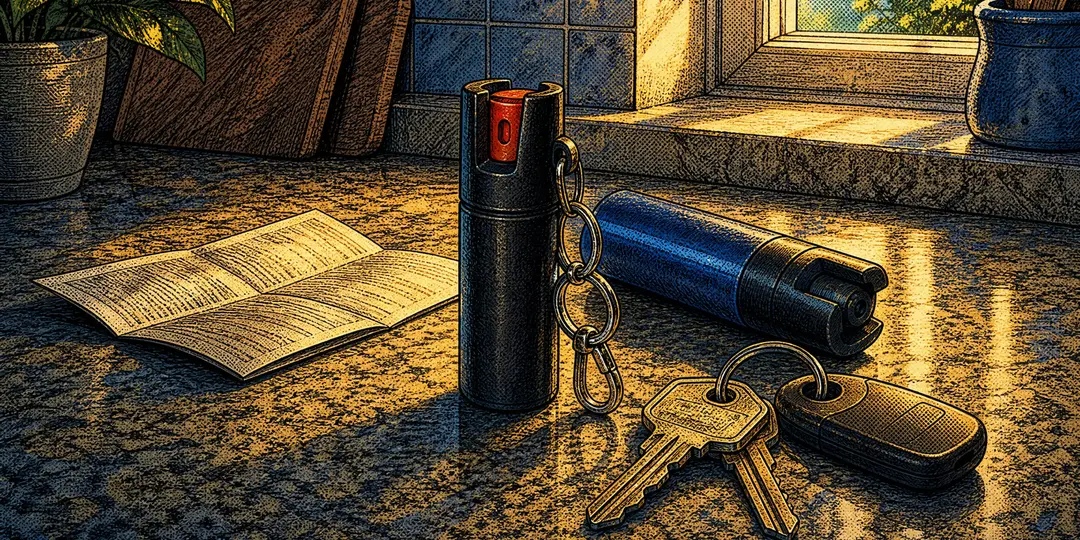
Pocket canisters run from about 0.5 oz (15 ml) on a key ring to roughly 1.5–2 oz (45–60 ml) for a belt or pocket unit. A small key-ring canister usually holds a handful of one-second bursts; a larger one holds more and reaches farther. The trade-off is pocket space and, in some states, legality. For most houses a pocket unit kept in a known place is enough.
Strength: MC, not OC
The front of the canister often shows an OC percentage (oleoresin capsicum). That figure describes how much pepper extract is in the liquid, not how hot that extract is, so a high OC number can be weaker than a low one. The more useful figure is major capsaicinoids (MC), the measure of the compounds that actually cause the effect. Reputable makers print it. Compare MC between canisters, ignore the Scoville marketing, and don’t pay extra for a headline OC number.
Some canisters add UV marking dye or CS tear gas. Dye doesn’t matter much either way; CS combinations are restricted in some states, so a plain OC formula is the simpler choice.
Expiration date and the safety
Every canister has an expiration date; manufacturers commonly rate them for around two to four years from manufacture. Check the date in the store, replace on it even if the canister feels full, and fire the old one outdoors, downwind of nobody, before you throw it away.
Look at the safety before you buy. Flip-top safeties are quick to open with a thumb and hard to open by accident; twist-collar safeties are compact but fiddly in winter gloves.
What to pay, and what is not worth buying
| Item | Typical price band | Worth it? |
|---|---|---|
| Key-ring stream canister, about 0.5 oz | $10–20 | Yes, if you will actually carry it |
| Pocket or belt gel canister, about 1–2 oz | $15–30 | Yes; the household default |
| Matching inert practice canister | $10–15 | Yes; the best $10 in this category |
| Larger home-defense canister | $20–45 | Only if your state allows it and you have a plan for where it lives |
Buy from an established maker that prints the MC figure and an expiration date, and that sells an inert trainer for the same canister. The trainer is what turns a purchase into a skill: ten minutes in the yard with it teaches you the safety, the aim and how far the canister really reaches. Our general rules for buying gear, and why we prefer boring, well-documented products, are in how we test gear.
Skip anything with no MC figure or expiration date, novelty shapes (lipstick, pen), multi-packs from unknown sellers, and anything sold with fear-heavy copy.
The law: check your state before you buy
Pepper spray is legal for adults to carry in some form in every state, but the details vary a lot, and they change. This is general information, not legal advice. Before you buy, check your state attorney general’s site or the state statute, or ask a local attorney. Our self-defense and weapons laws by state reference is a starting point. Things that commonly differ:
- Size caps. Several states limit canister size. California, for example, caps it at 2.5 oz, and some states set much smaller limits.
- Where you can buy it. A few states restrict sales. New York limits sales to licensed firearms dealers and pharmacists, in person (a bill to let other retailers sell it passed the legislature in May 2026 but was still awaiting the governor at our Nov 1, 2026 check); Massachusetts limits sales to licensed dealers. In those states, online orders will not ship to you.
- Age and eligibility. Most states set a minimum age, often 18, and bar people with certain convictions.
- Formula. Some states restrict CS tear gas or limit formula strength.
- Places. Schools, courthouses, federal buildings and many workplaces ban it regardless of state law.
Using spray on a person is a use of force. Whether it was lawful depends on your state’s self-defense law and the facts, the same as any other use of force.
Flying: pepper spray is not allowed in carry-on bags. The TSA allows one small canister (up to 4 fl oz, 118 ml) with a safety mechanism in checked baggage; check the TSA’s current rule, your airline’s rule and your destination’s law before you pack it.
Storage, practice and decontamination
- Where it lives. Out of children’s reach, in the same place every time: a jacket pocket, a bag pocket, a drawer by the door. Many makers advise against long periods in a hot or freezing car; check the temperature range on the label.
- Practice with inert. Draw, open the safety, fire a one-second burst, step off the line. A few minutes a month with the trainer is enough. It also tells you whether the canister you chose fits your pocket and your hands; everyday carry that fits in a normal pocket covers the rest of that kit.
- If you get it on yourself. Move to fresh air, flush with lots of cool water, don’t rub, take contact lenses out. The effects usually ease over 30–45 minutes. Anyone with asthma or breathing difficulty who has been exposed should get medical help.
Quick answers
What is the best type of pepper spray for home and carry?
Gel pepper spray suits most households. It reaches about as far as a stream, roughly 10–18 ft (3–5.5 m) by typical label claims, resists wind better than a cone or fog, and sticks to what it hits, so less of it floats around a room or back onto the person spraying or anyone standing nearby.
How far does pepper spray actually reach?
Most pocket pepper sprays claim about 8–15 ft (2.4–4.6 m), and gel up to about 18 ft (5.5 m), measured in still air from a full canister. Expect less from a part-empty or cold canister, or into a headwind. Most defensive use happens at roughly 6–10 ft (1.8–3 m), so a solid hit at 10 ft is enough.
Is a higher OC percentage stronger pepper spray?
No. The OC percentage shows how much pepper extract is in the liquid, not how hot that extract is. The better measure of strength is major capsaicinoids (MC), which reputable makers print on the canister or their website. Compare MC figures between products and ignore headline OC or Scoville numbers.
Is pepper spray legal in every state?
Pepper spray is legal for adults in some form in every state, but states differ on canister size, where it can be bought, minimum age and formula. California caps canisters at 2.5 oz, for example, and New York restricts sales to licensed dealers and pharmacists. Check your state attorney general’s site or a local attorney before buying.
Printable
Defense & security inventory checklist (PDF, 1 page). Log each canister, where it lives and its expiration date.



 4


Comments
No comments yet. Read the comment guidelines before posting.