


If your household is thinking about buying your first firearm, the decision deserves the same order you’d give any other serious purchase with risks attached: learn first, plan the storage, read the rules, then buy. Most of the problems people have with a first gun come from doing it the other way around. This guide sets out that order and the honest trade-offs, including the risks inside the home, which are larger than most people assume.
It is not legal advice. Firearm law in the US differs sharply between states and sometimes between cities. The authority is your state attorney general’s website, your state police, and a local attorney if you have a specific question. Our overview is Self-defense and weapons laws by state: the reference.
Start with the question, not the gun
Before any course or store visit, write down what the firearm is for. Home defense, hunting, sport shooting and carrying outside the home are different decisions with different equipment, training and law. For most households, the honest answer is “home defense,” and that brings two facts into view.
First, the layers before any weapon do most of the work: a hardened door, lights, a dog, neighbors, and the habits in self-defense for ordinary people. A firearm is the last layer, not the first.
Second, a firearm in the home is far more likely to be involved in a suicide or an accident than in stopping an intruder. That is not an argument against owning one. It is the reason storage and training come first.
Step 1: training before purchase
A basic course before you buy tells you whether ownership suits your household, which type of firearm fits you, and how to handle one safely. Most ranges and many community colleges run them; some states require a course for a purchase permit or a carry license.
What a good basic course covers: the safety rules, how the common types of firearm work, safe loading and unloading, storage and transport, the basics of the law in your state, and supervised live fire at a range. Many ranges rent firearms, so you can try several before buying.
Cost: roughly $75–250 for a basic course, plus range fees and ammunition. A state carry-license course, where required, often costs $100–300. Ongoing practice runs $20–50 a session.
The four safety rules, in the form most instructors teach them:
- Treat every firearm as if it is loaded.
- Never point the muzzle at anything you are not willing to destroy.
- Keep your finger off the trigger until your sights are on the target and you have decided to fire.
- Be sure of your target and what is beyond it.
Rule 4 matters most indoors: interior walls stop very little, and children sleep behind them. A course will cover this; it is also a reason to think hard about where in the house a firearm would ever be used.
Step 2: storage, before the firearm comes home
Storage has one job: the firearm is available to the adults who are trained to use it and to nobody else. That means children, teenagers, visitors, a family member in crisis and a burglar.
| Option | Rough cost | Good for | Limits |
|---|---|---|---|
| Cable or trigger lock | $0–20 (often free from police departments) | Rendering a firearm inoperable in storage or transport | Not theft-resistant; the gun can be carried off |
| Lockbox | $30–80 | Transport, a car, a secondary location | Light; can be pried or carried away unless bolted |
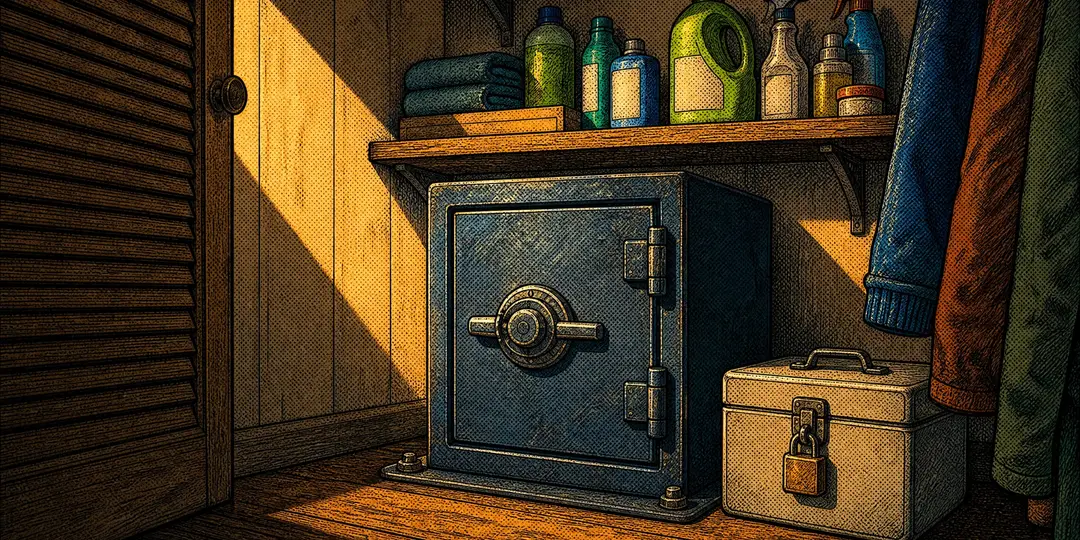
| Quick-access handgun safe | $100–300 | A single firearm kept for home defense | Choose keypad or key backup; bolt it down |
| Full-size gun safe | $500–2,000+ | Several firearms, long guns, documents | Heavy, needs floor space and installation |
Store ammunition separately where you can; keep keys and codes where children cannot find them; and keep the safe bolted to the floor or a wall. Biometric safes are convenient but vary in reliability; whatever you choose, have a backup way in that you have tested.
The law on storage varies. Around half the states and DC have some form of child access prevention law, which can make an adult criminally liable if a child gets access to an unsecured firearm. Some states and cities require locked storage in all circumstances. Check yours. Safe storage with kids in the house goes into the options, the conversations with children and the question to ask other parents.
Step 3: the law, and the purchase process
The federal baseline, in outline: buying from a licensed dealer means filling in ATF Form 4473 and passing a background check through the FBI’s NICS system (or a state equivalent). Federal law sets minimum ages of 18 for long guns and 21 for handguns from dealers, and prohibits purchase by certain categories of people, including those with felony convictions or certain domestic-violence convictions and those subject to certain protective orders.
States add a great deal on top:
- Permits to purchase or ownership licenses in some states, often with a course and fingerprints.
- Waiting periods of several days in some states.
- Private-sale rules: some states require private sales to go through a dealer with a background check; others don’t.
- Restrictions on particular firearms, magazines or features in some states.
- Carry rules: permitless carry in some states, a license with training in others, and many places where carry is prohibited regardless.
- Transport rules for driving between states with a firearm.
The safest approach is to read your state attorney general’s or state police firearm pages before you shop, and ask the dealer and the course instructor about anything unclear. If you move, read them again.
Step 4: the risks in the home, stated plainly
These are uncomfortable, and they belong in the decision.
Suicide. According to the CDC, firearms are involved in more than half of US suicides, and suicides account for more than half of US firearm deaths. Research reviews have found that access to a firearm in the home is associated with a markedly higher risk of suicide for everyone in the household, largely because suicidal crises can be brief and firearms are far more often lethal than other methods. Locked storage, and temporarily moving firearms out of the home when someone is struggling, are the practical responses. Some states have extreme risk protection order laws; some gun shops and ranges offer temporary storage. The 988 Suicide & Crisis Lifeline (call or text 988) is there for anyone in the household, including the owner.
Accidents. Unintentional shootings in the home most often involve children or teenagers finding an unsecured firearm, or adults handling one carelessly while cleaning or showing it. Training and storage are the controls.
Theft. A firearm stolen in a burglary is a common route by which guns reach people who can’t legally buy them. A bolted safe matters here too.
Misidentification. Every year there are cases of people shooting a family member they mistook for an intruder. A plan for a nighttime noise (light first, identify, call 911, stay in the bedroom) is part of training.



 4
Comments
No comments yet. Read the comment guidelines before posting.