


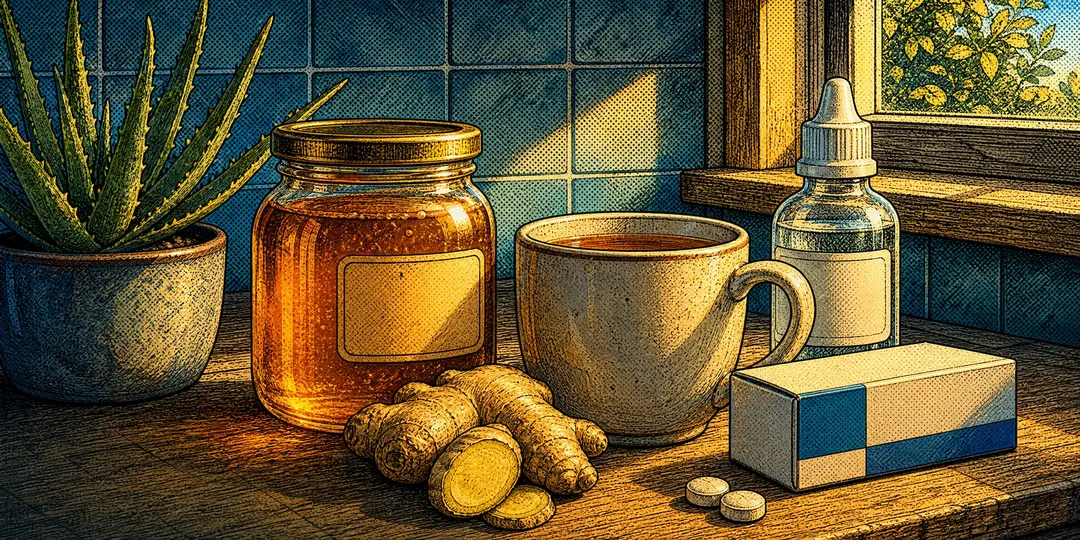
Herbal first aid kits sell well because they look calm and capable: amber bottles, a canvas roll, a tin of salve with a hand-drawn label. Open one and the contents are fairly consistent. Most of them contain two or three things that help with minor problems, several that are pleasant but unproven, and nothing at all for the injuries a first aid kit exists to handle. This guide goes item by item, grades each one against what NCCIH and Cochrane say, and names the pharmacy alternative where there is a better one.
It is not medical advice. Read it alongside Natural remedies: what the evidence supports and what it doesn’t, which covers interactions and the people who should avoid particular herbs.
What a first aid kit has to do
Before grading the contents, it helps to be clear what the kit is for. A household first aid kit covers four jobs: stop bleeding, clean and cover wounds, manage pain and fever, and deal with the small stuff (splinters, stings, rashes, blisters, upset stomachs) so it doesn’t become a doctor’s visit.
Herbal kits address the fourth job and part of the third. Very few include enough dressings for the second, and none can do the first. That is the main criticism, and it is fixable: treat an herbal kit as an add-on pouch, not as the kit.
Item by item
Honey (or medical-grade honey dressings)
Evidence: Supported for coughs in children over one (Cochrane). For wounds and burns, Cochrane found some evidence that medical-grade honey dressings help partial-thickness burns heal, with low certainty, and less for other wounds.
Verdict: Keep honey for coughs. For wounds, the evidence applies to sterile, medical-grade honey dressings, not a squeeze bottle from the grocery store, which is not sterile. Never give honey to a baby under 12 months.
Better alternative for wounds: Clean with water, petroleum jelly or antibiotic ointment, a non-stick dressing.
Aloe vera gel
Evidence: Plausible for minor burns and sunburn; studies are small and mixed.
Verdict: Keep it. It is cheap, soothing and low-risk on unbroken skin after the burn has been cooled under running water for 10–20 minutes. The cooling does most of the work.
Watch for: Products with added lidocaine or fragrance; skip those for small children. Never swallow aloe latex.
Witch hazel
Evidence: An astringent with long traditional use for minor skin irritation and hemorrhoids; good trials are scarce.
Verdict: Harmless and pleasant on insect bites and minor irritation. Not an antiseptic for wounds; most commercial versions contain alcohol and sting.
Better alternative: Hydrocortisone 1% cream does more for itchy bites and rashes.
Arnica
Evidence: Topical arnica for bruising has mixed results; several trials found no meaningful effect. Most herbal kits include a homeopathic version, which is so diluted it contains practically none of the plant.
Verdict: Optional filler. Use only on unbroken skin. Undiluted arnica taken by mouth is toxic.
Better alternative: Ice wrapped in a cloth for 20 minutes, then ibuprofen or acetaminophen if needed.
Tea tree oil
Evidence: Plausible for acne and athlete’s foot when diluted. Some antiseptic activity in lab studies, but no good evidence it beats soap and water for cuts.
Verdict: Optional. Must be diluted to avoid skin irritation and allergic reactions. Toxic if swallowed, including in small amounts by children and pets, so it needs the same storage as medicines.
Better alternative: Soap and clean water for cuts; an antifungal cream (clotrimazole or terbinafine) for athlete’s foot.
Calendula salve
Evidence: Small studies suggest some benefit for skin irritation from radiation therapy and minor wounds; not strong.
Verdict: A fine moisturizing balm for chapped skin and minor scrapes. Not a reason to buy the kit.
Better alternative: Plain petroleum jelly keeps a scrape moist and covered, for a fraction of the price.
Lavender oil
Evidence: Some small studies on anxiety and sleep with oral lavender preparations; little for wounds or burns.
Verdict: Comfort only. Not a burn treatment. Keep away from children’s mouths.
Clove oil
Evidence: Eugenol, the main compound, has long been used in dentistry, and clove oil can give short-term relief from toothache.
Verdict: Earns a place for a dental emergency during an outage, applied sparingly on a cotton swab to the tooth, not the gum. It can irritate soft tissue. It buys time; it does not fix the tooth.
Better alternative: A pharmacy dental kit with temporary filling material ($8–15) plus ibuprofen.
Ginger and peppermint (tea or chews)
Evidence: Ginger is supported for pregnancy nausea and plausible for other nausea; peppermint oil capsules are supported for IBS.
Verdict: Keep ginger chews or tea for nausea. Useful in a car kit too.
Yarrow, cayenne and “styptic” powders
Evidence: Traditional claims for stopping bleeding; no good evidence.
Verdict: Remove. For a shaving nick, pressure works. For anything serious, direct pressure, wound packing and a tourniquet are the treatment, and putting powders in a wound makes the hospital’s job harder. Stop the bleed: the first three minutes explains what to do instead.
Echinacea and elderberry tinctures
Evidence: Mixed to unsupported for colds and flu.
Verdict: Optional. Tinctures are usually alcohol-based, so not for children or anyone avoiding alcohol.
The scorecard
| Item | Keep, optional or swap | Pharmacy alternative | Alternative cost |
|---|---|---|---|
| Honey | Keep (coughs) | — | $5–10 |
| Aloe gel | Keep | — | $5–10 |
| Clove oil | Keep | Dental first aid kit | $8–15 |
| Ginger | Keep | — | $4–8 |
| Witch hazel | Optional | Hydrocortisone 1% cream | $4–8 |
| Calendula salve | Optional | Petroleum jelly | $3–5 |
| Tea tree oil | Optional | Antifungal cream; soap and water | $5–10 |
| Arnica | Optional filler | Cold pack, ibuprofen | $5–10 |
| Lavender oil | Comfort only | — | — |
| Yarrow / styptic powder | Remove | Gauze, pressure dressing, tourniquet | $30–60 |
The cost comparison
Pre-assembled herbal kits sold online generally run $40–100, and most of that pays for the bottles and the pouch. A conventional store-bought kit for a household runs $20–40, and the additions that make it properly useful (more gauze, a pressure dressing, tape, tweezers, a SAM-style splint, oral rehydration salts, a dental kit) add another $25–50.
| Option | Rough cost | Covers bleeding | Covers wounds | Covers minor ailments |
|---|---|---|---|---|
| Herbal kit alone | $40–100 | No | Barely | Partly |
| Conventional kit alone | $20–40 | Minor only | Yes | Mostly |
| Conventional kit plus additions | $45–90 | With a bleeding-control add-on | Yes | Yes |
| Conventional kit plus four kept herbal items | $65–120 | With a bleeding-control add-on | Yes | Yes, with comfort options |
If you already own an herbal kit, don’t throw it out. Pull the yarrow or styptic powder, check the dates, move the tea tree and lavender oils somewhere children can’t reach, and put the rest in a labeled pouch next to the main kit. What to add to a store-bought first aid kit lists the additions in order.



 4


Comments
No comments yet. Read the comment guidelines before posting.