A backyard in daylight with a paracord ridgeline strung between two trees under a green tarp, a clothesline with a towel beside it, and a hank of orange paracord on a camp chair.
Two of the eight on one afternoon: a tarp ridgeline and a clothesline, both from the same hank.
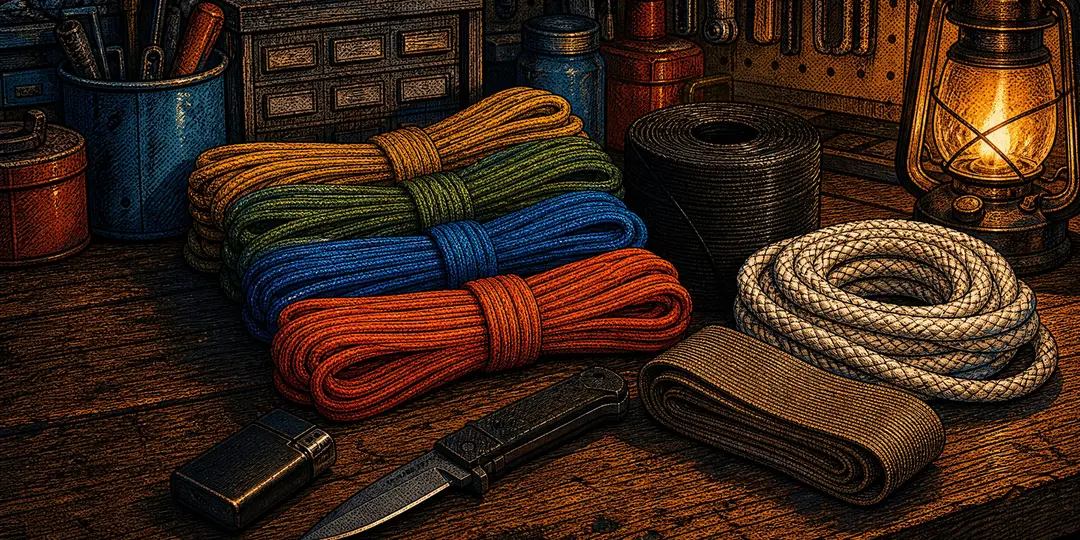
A 100 ft (30 m) hank of paracord, a lighter, a knife and four knots will do every project on this page. These are the paracord uses that earn their keep: each one takes ten minutes or less, uses cord you already own, and solves a real problem during an outage or a camping weekend. None of them is a bracelet: a bracelet unravels into perhaps 8–12 ft (2.5–3.5 m) of cord with a dozen kinks in it, and you would do better with a small hank in your pocket.
Two colors help: one for lines you’ll leave up, one for everything else
Lighter
1
For sealing ends. Do it outdoors or over a sink; melted nylon drips and burns
Knife or scissors
1
A sharp edge cuts cleanly; a dull one frays the sheath
Tape and a marker
A few inches
Label pre-cut lengths
Small carabiners or toggles
2–4, optional
Make lines quicker to put up and take down
Stakes, a small cloth bag, a stick
As needed
For the guy lines and the food hoist
Before you start, for every project: cut the length, then seal both ends. Hold each end briefly in the flame until the sheath and core melt together, then, while it is soft, press it flat with the side of the knife blade or roll it between wet fingertips. A sealed end won’t fray and threads through grommets easily.
The parts, and the difference a sealed end makes: the left one will fray in a day, the right one won’t.
1. A tarp ridgeline
Length: 25–30 ft (7.5–9 m). Knots: bowline or a round turn and two half hitches at one end; trucker’s hitch at the other.
Tie a fixed loop around the first tree, at about chest height, with a bowline or a round turn and two half hitches.
Walk the line to the second tree, pass it around the trunk and tie a trucker’s hitch so you can pull it tight and lock it.
Drape the tarp over the line, or clip its center tie-outs to the line with small carabiners or prusik loops.
For larger or heavier tarps, use bank line or rope; paracord stretches and sags in rain. The pitches are in tarp shelters: five pitches.
A ridgeline from tree to tree: bowline at one end, trucker’s hitch at the other, tarp draped over.
2. A clothesline that doesn’t sag
Length: 20–40 ft (6–12 m). Knots: bowline at one end, trucker’s hitch at the other.
During an outage the dryer is off, and wet clothes indoors add dampness to a cold house. A line on a porch, in a garage or between two hooks dries a family’s laundry.
Tie the fixed end to a hook, post or tree with a bowline.
Tension the other end with a trucker’s hitch, which you can retighten as the cord stretches.
Optional: twist the line slightly as you tension it so you can tuck cloth corners between the strands instead of using clothespins.
A garage clothesline for an outage: tensioned with a trucker’s hitch so it can be retightened as it stretches.
3. A food hoist
Length: 50 ft (15 m). Knots: bowline to tie off the bag; clove hitch or round turn and two half hitches to secure the line.
Put a fist-sized stone in a small cloth bag, tie the cord to it with a bowline, and throw it over a sturdy branch about 15 ft (4.5 m) up and well out from the trunk.
Swap the stone for the food bag, haul it up, and tie the free end off to another tree.
Where bears are present, check the land manager’s rules first. Many parks and forests require a certified bear-resistant canister, and a single-line hang is not enough there. At home, the same hoist lifts gear into a garage rafter or out of reach of a dog.
The food hoist: throw the weighted bag over a branch well out from the trunk, swap in the food bag, haul it up and tie off.
4. Replacement bootlaces
Length: measure the old lace and add 6 in (15 cm). Knot: none to make; tie your usual bow.
Cut to length and seal both ends, shaping them to a point while soft so they thread the eyelets.
Lace as usual. Paracord laces are thicker and slipperier than most, so a double knot helps.
Pull the inner strands out (“gut” it) first if the cord is too thick for your eyelets. Keep a pair in each car kit; a broken lace on a long walk home is a real problem. More on that in walking home in the shoes you’re wearing.
Paracord bootlaces: cut, seal, shape the end to a point while it is soft, and lace as usual.
5. Adjustable guy lines
Length: 6–10 ft (2–3 m) per line. Knots: bowline or lark’s head at the tent or tarp; taut-line hitch at the stake.
Attach one end to the tie-out with a bowline (or loop the cord and use a lark’s head).
Run it to the stake and tie a taut-line hitch around it. The hitch slides to tighten and grips under load.
Retighten at dusk; nylon loosens as it cools and gets wet.
Guy lines with a taut-line hitch at the stake: slide to tighten, and retighten at dusk.
6. Zipper pulls for gloved hands
Length: 4–5 in (10–12 cm) per pull. Knot: overhand knot or lark’s head.
Small zipper tabs on coats, bags and the emergency tote are hard to use in winter gloves. Thread a short length through each tab, tie an overhand knot in the ends, seal, and trim. In the dark, a bright color also helps you find the opening.
Zipper pulls you can grab in winter gloves, and find in the dark if the color is bright.
7. A carry handle for a bucket or a box
Length: about 3 ft (1 m). Knots: figure-eight loop; two half hitches.
Water containers, storage totes and buckets with thin wire handles are painful to carry full. A thick paracord handle spreads the load.
Tie the cord to both ends of the existing handle or two holes in the box, leaving slack to form a loop above.
Wrap a piece of hose or a folded cloth around the middle as a grip, or tie a figure-eight loop to hold.
A full 5-gallon (19 L) water container weighs about 42 lb (19 kg). That is well within paracord’s strength, but check the container’s own handle points, and lift with your legs.
A paracord handle with a hose grip: the cheapest upgrade to any heavy container you will carry in an emergency.
8. Lashing a load or a bundle
Length: 10–25 ft (3–7.5 m). Knots: clove hitch to start; trucker’s hitch to tension.
Tying firewood into a bundle, a sleeping pad to a pack, or a tarp over a load in a truck bed is the job paracord does most often.
Start with a clove hitch around one end of the bundle or one anchor point.
Wrap around the load, crossing the line at each wrap.
Finish with a trucker’s hitch to pull it tight and two half hitches to lock it.
For anything on a vehicle at road speed, use rated ratchet straps instead. Paracord is fine for a bundle on a pack or in a slow-moving wheelbarrow.
Lashing a bundle: clove hitch to start, crossing wraps, trucker’s hitch to tension, two half hitches to lock.
Paracord uses to avoid: tourniquets, climbing, towing
Paracord is often sold as an emergency tourniquet. It isn’t one. Thin cord concentrates pressure on a narrow strip, can damage tissue and nerves, and is hard to tighten enough to stop serious arterial bleeding. Buy a purpose-made tourniquet, keep it in the first aid kit and learn to use it in a class. Stop the bleed: the first three minutes explains where to start, and IFAK vs boo-boo kit where it goes.
The same goes for climbing, lifting a person and towing: paracord is the wrong tool, and the reasons are in the cordage guide.
Quick answers
How much paracord should I keep at home?
A 100 ft (30 m) hank of 550 paracord covers a tarp ridgeline, a clothesline, a food hoist, bootlaces, guy lines, zipper pulls, a carry handle and lashing a bundle, with some left over. Two colors help: one for lines you will leave up and one for everything else. Add a lighter and a sharp knife for cutting and sealing.
Can paracord be used as a tourniquet?
No. Paracord concentrates pressure on a narrow strip, can damage tissue and nerves, and is hard to tighten enough to stop serious arterial bleeding. Buy a purpose-made tourniquet, keep it in the first aid kit, and learn to use it in a hands-on class such as Stop the Bleed. Paracord is also the wrong tool for climbing, lifting a person or towing.
How do you seal the ends of paracord?
Hold each cut end of paracord briefly in a lighter flame until the sheath and core melt together, then press it flat with the side of a knife blade or roll it between wet fingertips while it is soft. Do it outdoors or over a sink, because melted nylon drips and burns. A sealed end won’t fray and threads through grommets easily.
How much cord is in a paracord bracelet?
Perhaps 8–12 ft (2.5–3.5 m), and it comes off with a dozen kinks in it. That is too short for most useful jobs, such as a 25–30 ft (7.5–9 m) tarp ridgeline or a 50 ft (15 m) food hoist line. A small hank of paracord in a pocket or a kit does far more than a bracelet.
Picks that match the specs in this guide, from makers with a track record. We haven't tested them yet. As an Amazon Associate we earn from qualifying purchases, at no cost to you. Add what you need to my list, then send the whole list to your Amazon cart all at once. Prices and availability are accurate as of the date and time shown and are subject to change. The price and availability shown on Amazon.com at the time of purchase will apply.
Atwood Rope MFG
Atwood Rope MFG 550 Paracord, 100 ft
550 paracord, 7-strand core, 100 ft, made in USA.
No price from Amazon right now (checked Nov 24, 7:06 a.m. CT)
Shane is a disabled US Army veteran who served as an M1A1 tank crewman, then spent his career in technology and manufacturing supply chains, keeping parts moving through COVID. He, his wife Heather and their three kids have ridden out tornadoes, the February 2021 Texas freeze, the 2026 floods in Northeast Texas and power outages that lasted days. He started Prepping Expert to give families the plain, affordable, step-by-step version he wished he'd had.
How to choose a survival knife: the blade length, steel, grind and sheath that cover camp chores and outage jobs for a household, and why $40–80 is enough.
We use Google Analytics cookies to count visits and see which guides help. No ads, nothing sold. Cookie policy






 4

Comments
No comments yet. Read the comment guidelines before posting.