


Everyday carry, or EDC, is what you have on you when something small goes wrong away from home. For a normal adult the everyday carry list is four items: a small light, a small blade or multitool, a way to pay, and a way to call someone. They weigh well under a pound together, they fit in ordinary pockets, and they cover nearly every situation EDC is honestly useful for. The rest of what you see in EDC photos online is a hobby, which is fine, but it isn’t preparedness.
This guide gives the four items, the criteria for picking each, the legal caveat on blades, and a simple test for whether your carry is real.
What everyday carry is actually for
Ignore the fantasy scenarios. Here is what the four items get used for, over a year of ordinary life:
- A dark stairwell or parking garage when the power fails, or a dropped key under a car seat at night.
- A stuck seatbelt, a tangle of string, a blister-pack that won’t open, a tag on new clothes, a split grocery bag that needs tying.
- A loose screw on a kid’s scooter, a glasses arm, a battery cover.
- A dead phone, a card reader that’s down, a parking meter that only takes coins, a taxi that only takes cash.
- Calling for help for yourself or someone else, and being able to see what you’re doing while you wait.
None of that is combat, and none of it needs a large knife. The items are tools for small, common problems, and they earn their place by being on you every day.
The everyday carry list: four items and how to choose each
| Item | What to look for | Weight target | Typical cost | Skip |
|---|---|---|---|---|
| Small light | A useful low mode, a pocket clip, USB charging or a common battery, fits a coin pocket | 1–3 oz (30–85 g) | $20–60 | Lights sold on peak lumens alone |
| Knife or multitool | Legal where you go; a blade under the local limit; scissors and a small screwdriver are more useful than a big blade | 1.5–6 oz (40–170 g) | $25–90 | Anything you’d hesitate to carry into a supermarket |
| Way to pay | One card plus $40–60 cash in small bills, in a slim wallet | Under 2 oz | Cash only | Bulky wallets that stay in the car |
| Way to call | The phone you own, kept charged; emergency contacts set up; a short cable | Phone + 1 oz | $5–15 for the cable | Second phones you won’t keep charged |
A small light
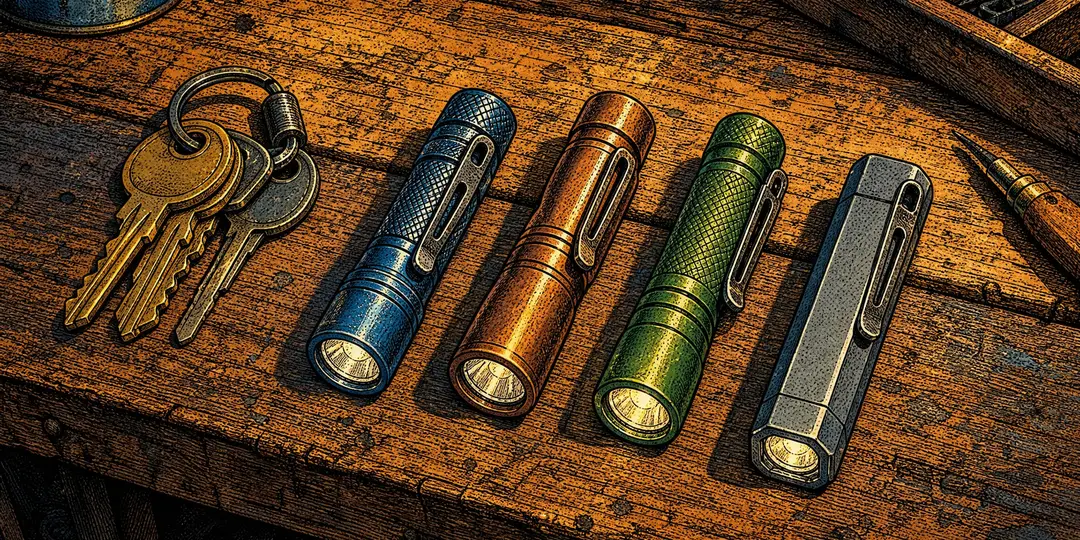
Your phone has a light, and it is fine until you need both hands or the battery is at 4%. A separate light that clips in a pocket solves both. The number on the box (lumens) is the least important spec: what matters is a low mode bright enough to walk by that runs for many hours, a clip that keeps it where you put it, a switch that doesn’t turn on in your pocket, and a battery you can keep charged. The flashlight buyer’s guide explains those specs, and choosing an EDC flashlight covers the specs that matter in a pocket.
A knife or a multitool
For most people a small multitool beats a knife, because scissors, a small screwdriver and a bottle opener get used more often than a blade does. If you prefer a knife, a small folding blade of 2–3 inches (5–7.5 cm) does every everyday cutting job. A large fixed blade is a camping tool; choosing a survival knife covers those, and they don’t belong in a work pocket.
Pick something you would be comfortable having seen at the office, at a school pickup, or at a restaurant. If you wouldn’t, you’ll leave it in the drawer, and then it isn’t EDC.
A way to pay
Card readers go down with the power and the network. Keep one card and $40–60 in small bills folded somewhere you won’t spend it: behind the ID in your wallet or in the phone case. Small bills, because nobody has change for a $50 when the register is down. A few coins for meters and machines, if that still applies where you live.
A way to call
You already carry this one. The preparedness part is keeping it useful: charge it before you leave the house, set up the medical ID and emergency contacts in the phone’s settings so a stranger or paramedic can reach your family from the lock screen, and carry a short charging cable so any USB port can top it up. A small power bank lives better in the get-home bag than in a pocket.
Knife law: check before you carry
Knife-carry law in the US varies by state, and many cities and counties add their own rules. Limits on blade length, opening mechanism, whether a knife is concealed, and where it can be carried all differ. Almost everywhere restricts knives in schools, courthouses and government buildings, and knives of any size are not allowed through airport security in carry-on bags.
That makes the safe default simple: a small folding blade or a multitool with a short blade, and a quick check of your own state and city before you carry anything. Knife carry laws by state is our starting reference, and your state attorney general’s site or a local attorney is the authority if you’re unsure. If your work or a building you visit often bans blades, a bladeless multitool with scissors covers most of the same jobs.



 4
Comments
No comments yet. Read the comment guidelines before posting.