


A get-home bag answers one question: if the car can’t move and the trains have stopped, can you walk home today? For most commuters the distance is under 20 miles, and at an ordinary 3 mph that is about seven hours of walking, closer to eight with rests. The get-home bag list below covers what makes those eight hours uncomfortable rather than dangerous: water and a way to refill it, food, something to fix your feet, a layer for the weather, a light for the last hour, a map for when the phone fails, cash, and a way to tell the family you are on your way.
It is not a bug out bag. It is lighter, it has no shelter, and it assumes you sleep in your own bed tonight. The 15 lb bug out bag is the other job.
When you would actually walk
The realistic triggers are boring: an earthquake or ice storm that closes roads and bridges, a regional power outage that stops trains and traffic lights, a flood that blocks the highway, or a cell network so jammed that nobody can arrange a ride. In most of those the right first move is to wait at work until it clears. The bag is for the day it doesn’t, or the day the kids are at home alone and waiting isn’t an option.
| Distance home | Walking time at 3 mph | With breaks | Water to drink (warm day) |
|---|---|---|---|
| 5 miles (8 km) | 1 hr 40 min | 2 hr | 1 liter, no refill |
| 10 miles (16 km) | 3 hr 20 min | 4 hr | 2–3 liters, one refill |
| 20 miles (32 km) | 6 hr 40 min | 7–8 hr | 3–6 liters, two refills |
Carry one liter and refill twice on the way; carrying six liters (13 lb) from the start is the mistake that turns a long walk into a short one. Plan the refills before you need them, which is what the route plan below is for.
The get-home bag list, with weights
Weights are typical for ordinary versions of each item. The total with a full liter of water is about 8–10 lb (3.5–4.5 kg) for the desk bag, more for the car version because of the shoes.
Water
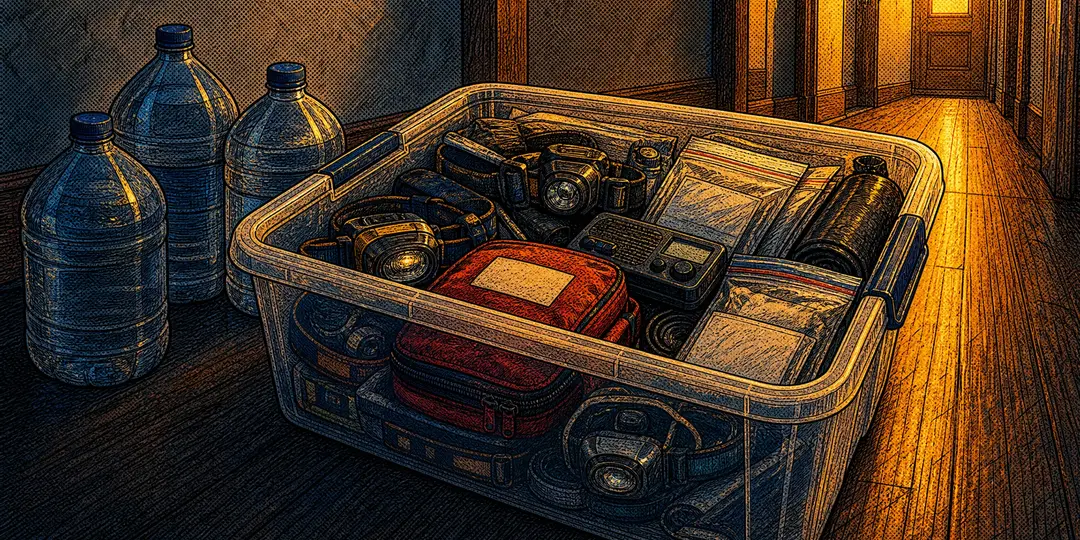
- Water bottle, 1 liter (34 oz), full — 2.3 lb (1 kg) — the first two hours, before the first refill
- Squeeze-type water filter — 3 oz (85 g) — refill from a tap, a fountain or, at worst, a creek
- Purification tablets, 10–20 — under 1 oz — backup if the filter freezes or clogs
Food
- Bars or trail mix, 1,500–2,000 calories — 1 lb (450 g) — something you’d eat anyway, swapped every six months
Feet
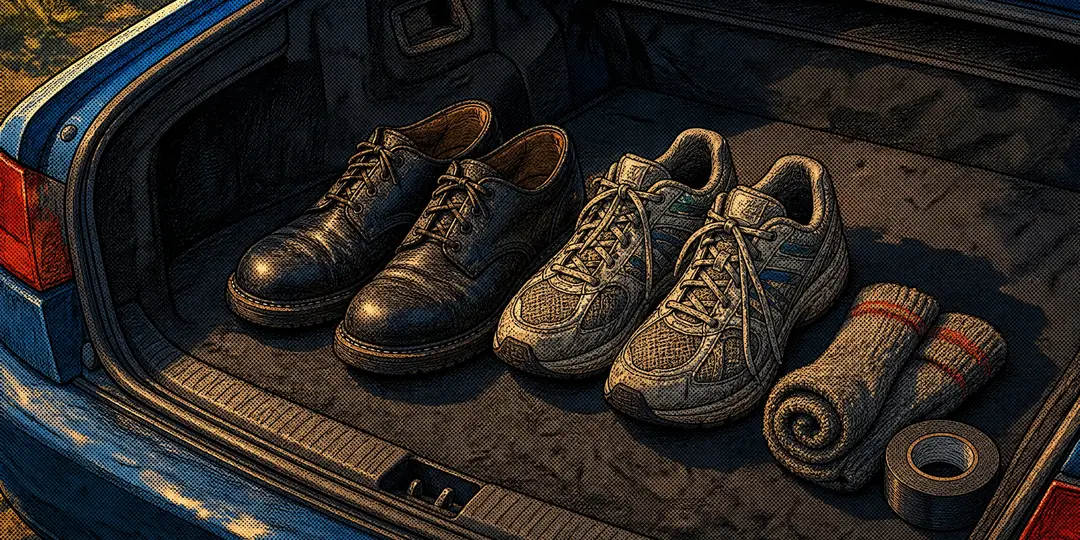
- Spare socks, synthetic or wool — 3 oz — a dry pair at the halfway point
- Blister kit: tape, a few blister dressings, a small tube of lubricant — 2 oz — fix the hot spot at mile three, not the blister at mile ten
- Sneakers you have already walked in (car bag only) — 1.5–2 lb — the single biggest upgrade; see walking home in the shoes you’re wearing
Layers
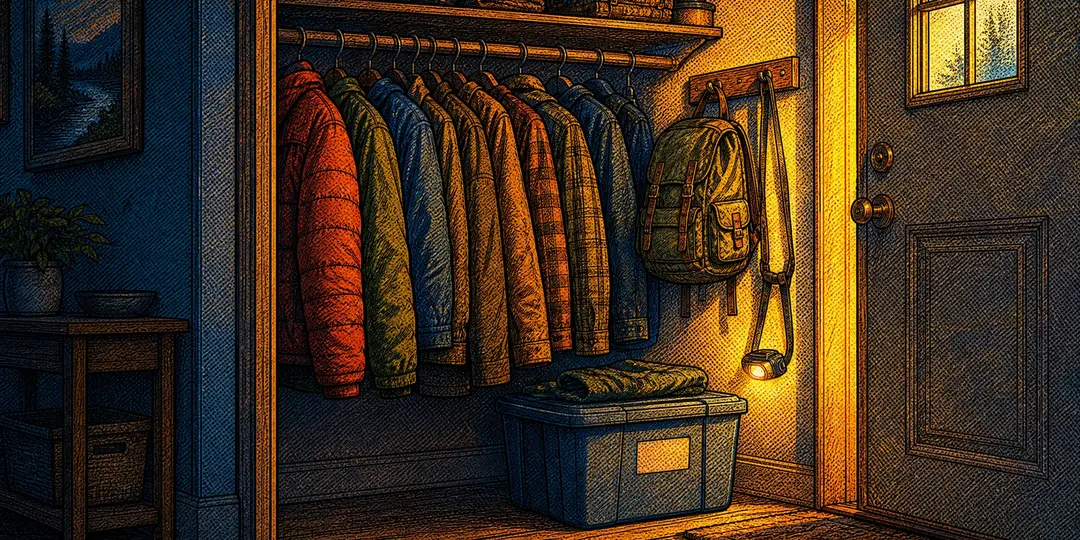
- Packable rain jacket — 10–16 oz — wind and rain, and the outer layer for cold
- Warm hat and thin gloves — 4 oz — the cheapest warmth per ounce there is
- Emergency blanket or bivy — 3–8 oz — if you are stuck waiting somewhere cold
Light and navigation
- Headlamp with spare batteries — 3 oz — the last hour of a winter walk is in the dark; the headlamp guide covers what to buy
- Paper road map of the area between work and home, routes marked — 2 oz — phones die and the network may be down
- Small baseplate compass — 1 oz — see compass and map for people who rely on their phone
Money and comms
- Cash, $50–100 in small bills — negligible — card readers go down with the power
- Power bank and cable — 6–8 oz — two full phone charges
- Card with family phone numbers and the meeting point written on it — negligible — nobody remembers numbers anymore
- Whistle — under 1 oz — cheap, loud, and works when your voice doesn’t
Health and the rest
- Small first aid kit plus a day of your own medication — 6 oz — see IFAK vs boo-boo kit
- Dust mask (N95), hand sanitizer, a few tissues and a zip bag — 3 oz — smoke, dust and public restrooms
- Small multitool — 3–5 oz — check local carry laws if it has a blade
- The bag: a plain daypack of 15–25 liters — 1–2 lb — something that won’t look odd in an office
Car version, desk version
The car bag can afford the sneakers, a heavier coat and two liters of water, because the car carries it. Store water in a bottle that tolerates heat and cold, and expect to replace it each season; a car in summer is hot enough to degrade bars and batteries quickly. Keep the bag in the cabin or the trunk, not under a pile of sports gear.
The desk bag has to fit in a drawer or under the desk and survive office life, so it is slimmer: the water, filter, food, socks, blister kit, rain shell, headlamp, map, cash and power bank. Keep a pair of flat shoes at the desk separately; they count as part of the kit.
In winter, add a warm insulated layer, thick socks, a second hat, chemical hand warmers and a thermos if you can fill it before you leave. Walking time stretches by a third on snow and ice, so recompute the table. If you drive, the winter car kit covers the car itself, and staying with a stuck car is often the right call; stuck in snow explains when.
The route plan: two ways home, drawn once
The bag is half the kit. The other half is a route you’ve looked at before the day you need it.
- Draw two walking routes on the paper map, one main and one alternative. Avoid the highway (often closed to pedestrians), long bridges if you live in earthquake or flood country, and low roads that flood.
- Mark the water points: gas stations, parks with fountains, libraries, a friend’s house. You want one every 6–8 miles.
- Mark the shelter points: fire stations, libraries, malls, a relative’s house, anywhere warm and lit where you could wait if it gets dark or the weather turns.
- Walk or drive part of it once, so the landmarks are familiar. Drive it slowly on a weekend and you’ll notice the fence that isn’t on the map.
- Agree on the plan at home: who picks up the kids, where people wait, and that you will text rather than call, because texts get through a congested network more often than calls. The meeting-point conversation covers the rest.



 4
Comments
No comments yet. Read the comment guidelines before posting.